
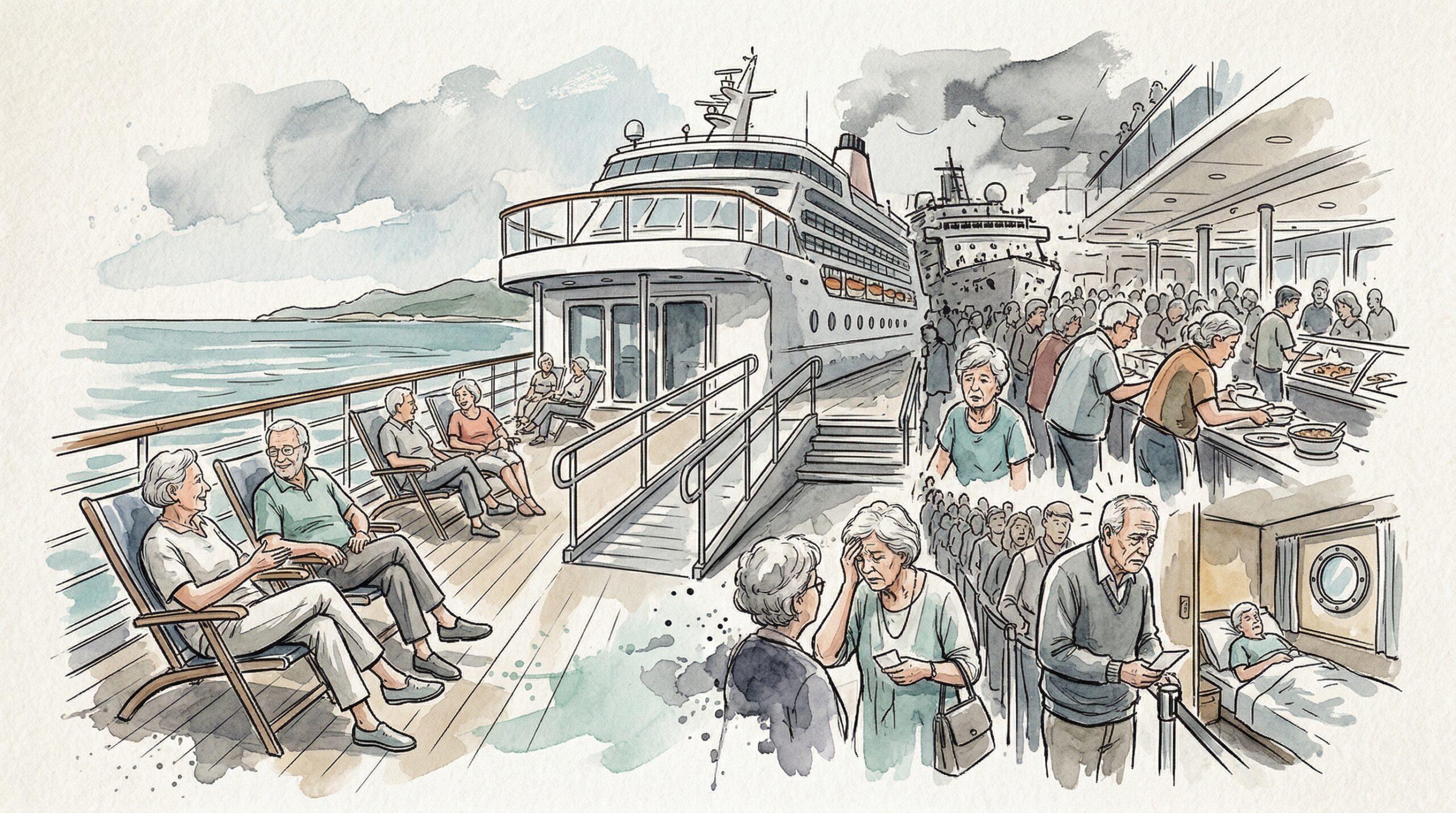

If you want a genuinely easy first cruise built around people your own age, book Holland America’s Koningsdam or Zuiderdam on a 7-night Caribbean or Alaska sailing for roughly $1,200–$1,900 per person in a veranda stateroom. Koningsdam posted a perfect 100/100 on its most recent CDC inspection — you can check it yourself in our cleanest cruise ships database — and Holland America’s passenger base skews older than almost any mainstream line, so nobody’s dodging a foam party at 2pm.
Last updated: October 28, 2026
If mobility is the priority over price, Viking Ocean is the strongest pick: every stateroom fleet-wide has a veranda and a genuinely accessible bathroom layout, the fleet is 18-and-over, and 7 nights runs roughly $3,000–$3,600 per person with shore excursions included. And if the top requirement is “never rush,” Cunard’s longer Atlantic crossings and world-voyage segments on Queen Mary 2 or Queen Anne give you 2–4 sea days between ports instead of the back-to-back sprint most Caribbean itineraries force on you.
Most “best cruise for seniors” articles just repeat the same three lines (Holland America, Viking, Oceania) without saying why, and skip the two things that actually matter most: whether the ship’s medical facility can handle a real emergency, and what an accessible cabin actually costs versus a standard one. We track ship-level sanitation and crew-treatment data specifically because those are the two things a glossy brochure won’t tell you. Here’s the real breakdown.
Quick-Reference Best Cruise for Seniors Table
Skip to the 2026 Update | Skip to FAQ
| Cruise Line | Best For | 7-Night Price (pp) | What Makes It Work | The Catch |
|---|---|---|---|---|
| Holland America (Koningsdam, Zuiderdam) | First-time senior cruisers who want a same-age crowd, not luxury pricing | $1,200–$1,900 | 100/100 CDC score on Koningsdam; deep accessible-cabin inventory | Entertainment skews sedate; smaller ships mean fewer dining venues |
| Viking Ocean | Mobility-focused travelers who need guaranteed accessibility | $3,000–$3,600 | Every stateroom has a veranda; fleet-wide wheelchair access; 18+ means no running kids | Lowest crew-treatment score we track (63/100) despite a polished guest experience |
| Oceania | Foodie seniors who want smaller ships and slower port days | $3,000–$3,800 | Ships cap near 1,200–1,250 passengers; easy, walkable layout | Fewer dedicated accessible cabins than big-ship lines; itineraries still port-heavy |
| Regent Seven Seas / Silversea | Seniors who want zero decision fatigue — everything included | $5,000–$6,500+ | Unlimited included shore excursions; Regent’s crew-treatment score (83/100) is #2 industrywide; all-suite means no long hallway walks | The price, and a smaller onboard medical bay than mega-ships carry |
| Princess | Seniors already loyal to a familiar mainstream brand | $1,300–$1,800 balcony | Wide accessible-cabin count fleet-wide; calmer daytime programming than Carnival or Royal Caribbean | Newest ships bundle a mandatory $105/day Princess Premier package into Sanctuary bookings |
| Cunard (Queen Mary 2, Queen Anne) | Widowed or solo seniors who want built-in social structure | $2,600–$3,400 | Vetted “gentlemen hosts” as dance partners and dinner companions on longer voyages | Formal nights are frequent; the average age can feel institutional to some |
| Norwegian | Seniors cruising with adult kids or grandkids who still want accessibility | $1,400–$2,000 balcony | Prima-class ships have newer accessible pools with gradual-entry slopes, not just lifts | Freestyle Cruising means less structured routine; ships skew larger and busier |
| Carnival / Royal Caribbean mega-ships | Nobody who wants a quiet trip | $700–$1,100 | Cheapest fares in the industry | Icon-class and similar ships are built around waterparks; longest walk from cabin to dining room of any ship class |
For a full line-by-line breakdown, see our Cruise Line Dossiers.
The 2026 Shift: Insurance Costs Spike, Accessible Cabins Vanish Faster
Two things changed for senior cruisers heading into 2026 that most guides haven’t caught up to yet. First, Squaremouth’s 2026 Cruise Insurance Cost Report found that travelers over 70 now pay 311% more for cruise travel insurance than travelers under 50 — a direct result of medical evacuation coverage getting more expensive as claims rise. Budget for it as a real line item, not an afterthought: a $200,000–$250,000 medical evacuation limit is the number insurance brokers actually recommend for a senior sailing internationally, and it’s not optional the way it might feel on a domestic land vacation.
Second, accessible cabins are now selling out 12–18 months in advance on the most popular senior-friendly ships, driven by rising demand and a limited supply per ship (usually under 30 fully accessible staterooms even on a large vessel). If you’re eyeing a 2026 or 2027 Alaska or Mediterranean sailing and need a roll-in shower or a wider doorway, book now — waiting until 90 days out means the accessible inventory is already gone, full stop.
On the ship side, Royal Caribbean’s Legend of the Seas — the line’s third Icon-class ship, debuting in 2026 and repositioning to Fort Lauderdale for winter Caribbean sailings — is worth naming as the ship to skip if you’re a senior shopping by price alone. It carries 5,610 passengers and is built around the largest waterpark at sea; long corridors, big crowds at the elevators, and a family-first layout make it a genuinely poor fit regardless of how cheap the fare looks.
Mobility and Accessibility Realities, Ship by Ship
“Wheelchair accessible” means something different on every ship, and the differences matter. Royal Caribbean builds fully ADA-certified staterooms into its newer ships and even its private island, CocoCay, has beach wheelchairs and pool lifts — but you’re navigating a 5,000-plus-passenger crowd to use any of it. Holland America and Princess both carry deep accessible-cabin inventories because their guest base skews older, but that demand means those cabins book up first. Norwegian’s newer Prima-class ships added gradual-entry pool slopes alongside traditional lifts — a real upgrade over older ships that only offer a mechanical lift and nothing else. Viking Ocean is the simplest answer: the entire fleet was designed accessible from the keel up, so there’s no gamble on which cabin category or which specific ship you land on.
- General rule: the newer the ship, the more accessible it tends to be, and larger ships have more total accessible cabins even if the ratio per passenger isn’t better.
- Book early: accessible cabins are a fixed, small inventory (often under 30 per ship) and the popular sailings sell out 12–18 months ahead.
- Ask specifics: “accessible” can mean a roll-in shower and grab bars, or just a slightly wider door. Confirm exactly what’s in the cabin before booking, not after.
Medical Facilities at Sea: What to Actually Check
Every major cruise ship carries an onboard medical center with at least one physician and several nurses, basic diagnostic equipment, and telemedicine links to shore-based specialists. What most seniors don’t realize: Medicare does not cover medical care on a cruise ship, even in U.S. territorial waters, and it never covers medical evacuation. Onboard doctor visits are billed directly to your onboard account like a specialty restaurant, often $100–$200 for a basic consultation. This is exactly why the insurance shift above matters — a real travel insurance policy with medical evacuation coverage isn’t a nice-to-have for a senior cruiser, it’s the only thing standing between a shipboard emergency and a bill that starts with a comma.
Longer Itineraries and Slower Pacing
A back-to-back port schedule with a new island every single day sounds efficient but is exhausting — you’re packing and unpacking your energy level daily instead of settling into the trip. Look for:
- A healthy ratio of sea days: at least one full day at sea for every two or three port days, so there’s real recovery time built in.
- Overnight port stays: instead of a rushed 8-hour call, an overnight stay lets you see a city without racing the “all aboard” clock.
- Slower-cruising itineraries: Cunard’s transatlantic crossings and Viking’s and Oceania’s Mediterranean routes are built around fewer, longer port visits rather than a checklist of quick stops.
Single-Supplement Realities for Widowed and Solo Seniors
The cruise industry still prices fares “per person, double occupancy,” which means a solo cruiser — including a recently widowed traveler booking their first trip alone — often pays a 50–100% single supplement on top of the base fare. A few lines have built real alternatives: Holland America’s Solo Singles program discounts the supplement and organizes meet-ups aimed at an older solo crowd, and Norwegian’s Studio cabins (on Epic, Bliss, Encore, and several other ships) carry zero single supplement at all, though they’re compact at around 100 square feet. Cunard goes a different direction with vetted “gentlemen hosts” who serve as dance partners and dinner companions for solo women on longer voyages — an old-fashioned solution, but one that specifically targets widowed and solo older travelers rather than treating them as an afterthought. For the full line-by-line supplement breakdown, see our Solo Cruise Guide 2026.
Which Lines Skew to Which Age Profile
If cruising with people your own age matters to you, the average passenger age varies more between lines than almost any other factor. Holland America and Cunard both skew older — comfortably into the 60s and 70s on most sailings. Oceania, Regent Seven Seas, Silversea, and Viking Ocean draw a similar age range but with a higher household income, which shows up in pricing rather than pacing. Princess and Norwegian sit in the middle, mixing families, multi-generational groups, and older couples depending on the specific itinerary and season. Carnival and Royal Caribbean skew younger and more family-heavy across the board, especially on Caribbean sailings during school breaks — check our dress code guide by line if you’re weighing Cunard’s more formal culture against a more casual mainstream line,.
Whatever line you land on, budget properly for the crew who’ll be doing the actual physical work of your trip — carrying luggage, managing mobility equipment, and making repeat trips to your cabin. Our cruise ship tipping guide breaks down exactly who gets what and when a little extra cash is appropriate for above-and-beyond help.
FAQ: Best Cruise for Seniors
What are the best ocean cruises for seniors?
Holland America, Viking Ocean, Oceania, and Cunard are consistently the strongest choices for senior cruisers because their passenger base skews older, their pacing is slower, and their accessible-cabin inventory is deeper than mainstream family lines. Holland America is the best value entry point; Viking Ocean is the best choice specifically for guaranteed mobility access.
What is the best cruise line for seniors with mobility issues?
Viking Ocean is the strongest option because every stateroom fleet-wide was built accessible from the start, rather than a limited number of retrofitted cabins. Holland America and Princess also carry large accessible-cabin inventories, but those cabins book up 12–18 months ahead, so early booking matters more than the line you pick.
Which cruise lines have the most accessible cabins?
Holland America and Princess carry the deepest accessible-cabin inventories among mainstream lines, partly because their older passenger base drives more demand for them. Royal Caribbean’s newer ships have fully ADA-certified staterooms, and Norwegian’s Prima-class ships added gradual-entry accessible pool designs. Viking Ocean’s entire fleet is accessible by design rather than by cabin category.
Do cruise ships have doctors and medical facilities onboard?
Yes, every major cruise ship carries an onboard medical center with at least one physician, several nurses, and telemedicine access to shore-based specialists. However, Medicare does not cover cruise ship medical care or medical evacuation, and onboard doctor visits are billed directly to your account — often $100–$200 for a basic consultation.
What is the best cruise for a senior traveling alone?
Holland America’s Solo Singles program and Norwegian’s Studio cabins (with zero single supplement) are the two strongest options for a solo senior. Cunard’s transatlantic crossings, which include vetted “gentlemen hosts” as dinner and dance companions, are specifically built around widowed and solo older travelers rather than younger backpacker-style solo cruising.
Which cruise lines should seniors avoid?
Mega-ships like Royal Caribbean’s Icon-class (including the new Legend of the Seas) and MSC’s World-class ships are the weakest fit — they’re built around waterparks and family activities, involve long walks between the cabin and dining venues, and carry 5,000 or more passengers, which makes basic navigation harder for anyone with mobility limitations.
Do seniors need travel insurance for a cruise?
Yes. Medicare doesn’t cover any medical care at sea, and cruise insurance costs for travelers over 70 rose to roughly 311% more than travelers under 50 in 2026 due to rising medical evacuation claims. A policy with $200,000–$250,000 in medical evacuation coverage is the standard recommendation for senior cruisers sailing internationally.
The Bottom Line
For most first-time senior cruisers, Holland America is the safest starting point — a same-age crowd, a deep accessible-cabin inventory, and CDC scores (Koningsdam’s perfect 100/100 among them) that back up the line’s reputation for a well-run ship. If mobility access is non-negotiable rather than a nice-to-have, skip straight to Viking Ocean, where accessibility isn’t a cabin category to hunt for but a fleet-wide design choice.
Whichever line you choose, treat the two 2026-specific realities in this guide as non-negotiable: buy real travel insurance with a genuine medical evacuation limit, because Medicare stops at the gangway, and book any accessible cabin the moment your dates are set, because the popular ships are already selling that inventory 12 to 18 months out. Skip the mega-ships built around waterparks and school-break crowds — check the specific ship’s inspection score before you book, since the cruise line name tells you the vibe but not what you’re actually walking onto.
Ocean Cruises for Seniors: Which Ships Actually Fit
The short answer is to choose an ocean cruise for seniors by ship size, pace and medical planning. Adjectives like “relaxing” on a brochure won’t tell you any of that. (Every brochure says “relaxing.” I’ve seen a ship with a wave pool and a go-kart track say it.) Smaller ships with an older or adults-only crowd, like Oceania and Viking, suit most senior travelers better than a 5,000-passenger waterpark, and that’s true even when the waterpark is cheaper. Cunard’s Queen Mary 2 is the plot twist. It’s a 2,691-guest ocean liner, so it’s not small, but it has a very different rhythm from the floating theme parks.
The ocean options at a glance
| Ship or class | Guests | Why it suits seniors | Reality check |
|---|---|---|---|
| Oceania Regatta class (Regatta, Insignia, Nautica) | 684 | Small and quiet, with easy ports | Regatta has only three wheelchair-accessible cabins. That’s three, and the ship isn’t going to grow a fourth. |
| Oceania Marina and Riviera | 1,250 | Mid-size, with six wheelchair-accessible cabins each. Like the rest of the Oceania fleet, both have been 18+ for new bookings since January 7, 2026. | Six cabins is still a very short list |
| Oceania Allura (built 2025) | 1,200 | Newest ship in the fleet | Check the accessible inventory for your sailing |
| Viking Ocean | About 930 | 18+ only, and shore excursions are included | Priced well above mainstream lines |
| Cunard Queen Mary 2, 7-night transatlantic | 2,691 | A large ocean liner, but seven nights at sea with no port stops, so no gangway sprints | Expect at least two formal nights. Approximate “from” fares are $1,500 per person for an interior and $2,800 per person for a balcony, based on double occupancy. Prices vary by sailing date, availability and promotions. |
If you want to see how these ships compare on sanitation, run them through our CDC cruise ship inspection lookup. To see what a mid-size Oceania looks like, start with our Oceania Marina page.
Pace matters more than the itinerary
Most seniors don’t get tired of cruising. They get tired of a port every single morning: the 7 a.m. alarm, the tender line, the “we have to be back on board by 4:30” countdown that turns a lovely lunch into a sprint. Cunard’s crossing is the extreme version of the fix. It’s seven nights at sea with no port stops, and it’s the one itinerary where nobody is hustling you off the ship. On a port-heavy Caribbean loop, check the day-by-day schedule and count the sea days before you pay a deposit. Future you, sitting on a sunlounger with a book, will be grateful.
Budget for insurance like it’s a cabin category
Here’s the part nobody puts in the brochure. Squaremouth’s data shows that travelers over 70 pay at least 280% more for cruise insurance than travelers under 50. Yes, really. Its data for travelers 65+ also shows:
- The average senior cruise costs $6,942 and lasts 15 days. 80.6% of senior trips run longer than seven days.
- Squaremouth’s recommended minimums are $100,000 in emergency medical coverage and $250,000 in medical evacuation.
- 49.4% of seniors buy insurance too late. That can mean missing pre-existing condition waivers and Cancel For Any Reason coverage, both of which have purchase windows of 14 to 21 days.
The takeaway: buy the policy right after you book the cruise, not the week before you sail. Nobody has ever regretted doing this early, and plenty of people have regretted doing it late.
Your three-step shortlist
- Pick the size first. For a calm ship, stay at or under about 1,250 guests. Smaller ships are also easier to find your way around, which matters when your cabin is at one end and dinner is at the other.
- Confirm accessibility in writing. Ask for the specific cabin category, then book as soon as the sailing opens. Accessible cabins are scarce on every ship, and a friendly “we’ll sort it out” on the phone is not a booking.
- Sort out the medical side. Get the insurance policy, and ask the cruise line about the onboard medical center before you commit.
Sailing without a travel partner? Our solo cruise guide covers single supplements and the lines that handle solo travelers best.
Best Cruises for Elderly Travelers: What to Book at 75 and Up
“Senior” and “elderly” are different shopping lists. At 60 you’re choosing a vibe. At 80 you’re choosing a hallway length, a bathroom doorway and a ship’s doctor (the buffet can wait). Our short answer: Holland America’s Koningsdam if mobility is the priority, Viking Ocean if you want a smaller ship and can walk, and Cunard’s Queen Mary 2 if round-the-clock onboard medical staffing tops your list.
| If you need… | Book | Why it works | The catch |
|---|---|---|---|
| A wheelchair or scooter to be genuinely workable | Holland America Koningsdam | Holland America’s own room list shows 27 fully accessible staterooms (wide doors, roll-in showers) plus 13 ambulatory ones, on a ship with a capacity of 2,650 guests. | Holland America says standard stateroom doors and hallways “may be too narrow” for a wheelchair or scooter, and that bathroom dimensions, doorsills and tub heights are often difficult for guests with mobility limitations. Its ambulatory rooms have standard door sizes and a step up into the bathroom, so book a designated fully accessible room and don’t improvise. |
| A smaller ship | Viking Ocean (e.g. Viking Orion) | 930 guests, and every stateroom has a veranda. | Viking Orion lists just two wheelchair-accessible cabins (#6020 and #6021, both Penthouse Junior Suites). Book very early if you need one. |
| Round-the-clock medical staffing | Cunard Queen Mary 2 | Cunard says the medical centre on Deck 1 is staffed by registered doctors and nurses, available 24 hours a day for medical emergencies. | Cunard is upfront that there is no access to surgical or complex intensive care facilities, advanced imaging or medical specialists. It stabilises patients and doesn’t replace a hospital. |
The medical reality nobody puts in the brochure
A ship’s medical centre is a clinic with excellent oxygen and a very good defibrillator. It isn’t a hospital, no matter how fancy the carpet in the lobby is. Ship doctors handle heart attacks, strokes, dehydration and stitches, but not extensive surgery, advanced scans or specialist cardiology or neurology care. And the bills? They climb faster than the ship’s own gangway. The booking site CruiseBooking.com puts typical ranges at the figures below. They aren’t specific to any one cruise line, so check your line’s fees before you sail:
- Daytime consultation: $100–$200
- After-hours visit: $300–$600, before tests and medication
- Overnight in the infirmary: $1,000–$3,000 per day
- Helicopter evacuation: $50,000–$100,000, depending on distance and weather
Insurance is part of the fare
Squaremouth defines seniors as travelers 65 and over, so its figures describe a wider group than the 75-and-up crowd. It puts the average senior cruise at $6,942, and seniors average 15 days at sea against 11 for younger travelers. Its guidance is $250,000 of medical evacuation coverage, yet 35% of senior cruisers buy less than that. In its survey, 76% assumed Medicare would cover them abroad (spoiler: Medicare.gov says it usually doesn’t cover health care outside the U.S. There are narrow exceptions, including a ship’s doctor when the ship is in a U.S. port or no more than six hours from one). About half buy their policy too late to qualify for pre-existing condition coverage: Squaremouth’s senior cruise report puts it at 49.4%, while its senior cruiser survey says 55%. The window is generally 14–21 days after your first deposit. Buy the policy the week you book, not the week you pack.
How to pick the actual ship
- Book the accessible category, not “a room with a grab bar.” Inventory is tiny: 27 fully accessible staterooms on Koningsdam, two suites on Orion.
- Match the line to your age. One senior-travel guide estimates average passenger ages of 55–65 on Holland America, 55–70 on Viking and 60–75 on Regent. These are estimates, not official figures.
- Check the ship’s sanitation record. Norovirus hits older passengers hardest. Look up any ship in our CDC cruise ship inspection lookup, compare lines in the cleanest ships rankings, and see which sailings have made headlines on our outbreaks tracker.
- Skip the waterpark ships. Long corridors and crowded elevators are the opposite of what you want here.
Cruise Seniors: How to Pick, Pay for and Protect the Trip
Here’s the short answer for anyone searching “cruise seniors.” Pick a line that plans for older travelers. Holland America and Princess, the two below, both spell out how to ask for what you need, so they’re a handy place to start. If you need an accessible cabin, ask for it when you book. Buy insurance the same day you pay your deposit. Everything else is garnish, and yes, I’m aware that’s a bold thing to say about a blog post with a whole Medicare section. The numbers below are why.
Two lines worth a look
I’m not going to crown a winner, because “best line for seniors” depends on whether you want a cane-friendly bathroom, a bridge table or a solo cabin. (Anyone who tells you otherwise is selling something, probably a cruise.) I picked these two because each publishes detailed accessibility guidance, so you can see how to ask before you hand over a deposit. Here’s what they say themselves:
- Holland America: Its ships offer three accessible stateroom types: Fully Accessible, Fully Accessible with a Single Side Approach, and Ambulatory Accessible. The line encourages guests with accessibility needs to contact its Guest Accessibility Department and submit a Special Requirements Information (SRI) Form right after booking. It recommends sending it at least 45 days before sailing when possible, so the team has time to prepare. Onboard, it lists party bridge, pickleball, an adults-only pool and single staterooms on Pinnacle Class ships. Its accessibility page links to a “Contact Accessibility Team” page, and the line’s general number is 1-855-932-1711.
- Princess: Raise accessible-room needs when you book, through your travel advisor or Princess reservations. Princess says it can’t guarantee every request. Fully accessible rooms suit wheelchair and scooter users. Ambulatory rooms suit guests who use a cane or walker, and they have a step into the bathroom and onto the balcony. Princess’s accessibility team is at [email protected] or 1-800-PRINCESS (1-800-774-6237). It can’t help with reservations or room assignments, so those go through your advisor or reservations. It also recommends filling out its Mobility Questionnaire before you sail.
Not everyone over 65 needs an accessible cabin, and plenty of us are insulted by the suggestion. If you do need one, those pages are your starting point. Room availability differs by ship and sailing, so ask about your exact one.
What seniors actually spend and book
Squaremouth’s senior cruise report, built from policy sales between January 1, 2025 and January 1, 2026, gives the clearest picture of how travelers 65 and over really cruise. These are total trip costs, not cruise fares alone, so don’t go waving $6,942 at your travel agent and demanding a refund on the fare:
- Typical trip cost: $6,942 for travelers 65+, counting flights, hotels and excursions. That’s roughly $1,500 more than younger travelers spend.
- Length: 15 days on average, versus 11 for younger travelers. 80.6% of seniors take trips longer than 7 days. Turns out retirees have time. Shocking.
- Where they go: Mexico, the United States and the Bahamas make up 57.2% of senior policies.
- The budget reality check: The average senior ends up spending nearly $2,000 more than their preferred budget. Plan for the overshoot before it plans for you.
Medicare mostly stops at the gangway
This is the part nobody puts in the brochure, probably because it doesn’t photograph well next to a sunset. Original Medicare may cover medically necessary care on a cruise ship only if the ship is within 6 hours of a U.S. port, according to Humana’s Medicare guidance. Farther out, you’re paying out of pocket, and the Atlantic does not take assignment. Medigap plans C, D, F, G, M and N offer some foreign-travel emergency help, and Medicare Advantage plans vary, so read your own plan documents. Don’t assume. Assuming is how people end up writing very long, very angry reviews.
Then there’s the ship’s medical center, where the plot thickens. Royal Caribbean’s FAQ says it does not accept land-based health insurance plans onboard. You may be able to file a claim with your own insurer afterward, depending on your plan, and travel insurance or a credit card with travel coverage may be another route to reimbursement. KFF Health News reports that, per the American College of Emergency Physicians, medical charges are typically added to your onboard account and must be settled before you leave the ship, though billing differs by line. In other words, your sea-day sniffle can show up on the same bill as the spa package. Check your own line’s terms before you sail.
What insurance costs at 70-plus
Squaremouth’s cost page lists average comprehensive-plan premiums of $829 for travelers aged 70–79 and $1,069 for 80+. Under-50 travelers pay $195 (ages 22–34) or $268 (ages 35–49). Yes, that’s a gasp-and-clutch-the-pearls number. It stings, but the alternative stings more:
- Squaremouth’s recommended minimums are $100,000 in emergency medical coverage and $250,000 in medical evacuation.
- 32% of senior cruisers buy less than $100,000 of the first. 35% buy less than $250,000 of the second. That’s roughly one in three people deciding to wing it. Bold.
- Pre-existing condition and cancel-for-any-reason benefits generally require buying within 14–21 days of your first trip deposit. Buy late and those options are gone, and no amount of charm at the customer service desk will bring them back.
Do senior cruise discounts exist?
Sort of, and usually not as a standing discount, so put the “I’m 67, where’s my deal” speech away. The clearest example is AARP, whose Holland America page lists up to $200 in onboard credit per stateroom on select cruises, based on cruise length and stateroom. It also lists limited-time offers that go higher, up to $400 per stateroom, with their own dates and exclusions. That’s onboard credit, not money off the fare. It expires at the end of the cruise and can’t be used in the casino, so the slot machines will have to find another sponsor. Carnival is often named for 55+ fares, but we can’t point you to a published Carnival policy on them. Ask Carnival reservations or your travel agent about your specific sailing before you count on a saving.
Before you book
- Check the ship’s latest score in our CDC cruise ship inspection lookup.
- See whether your sailing’s ship has a recent illness history on our outbreaks page.
- Traveling alone or newly widowed? Our solo cruise guide covers solo supplements and the lines that actually help you meet people.
Senior Cruise: What It Means, What It Costs, and How to Book One
Here’s the secret nobody at the travel agency will say out loud: there is no such thing as a “senior cruise” ship. No line sells a vessel stamped SENIORS ONLY, complete with orthopedic shoes at the gangway. The phrase really means one of three things: a discounted fare for older guests, a sailing with an older crowd, or a trip built for ease. Here’s how each one works, plus the one fine-print item that can turn a dream trip into a very expensive nap.
1. The senior discount (and the age you need to be)
Royal Caribbean’s own FAQ says it offers “reduced senior prices only on selected sailings exclusively for guests who are 55 years of age and older.” Read that twice. “Selected sailings” means no automatic discount. “55” means you may qualify earlier than you’d like to admit. Its restricted-price rules also require at least one guest per stateroom to be eligible, and a booking that doesn’t comply can be repriced to the lowest available fare that day. Then you owe the difference right away, or your boarding rights may be denied. Dramatic? Yes. Fun at the pier? No. Other lines set their own ages and sailings, so confirm the terms at booking. Royal Caribbean is the only line whose terms are quoted here, so get any other line’s age and sailing rules in writing before you pay.
2. What older cruisers actually book
Squaremouth’s 2026 data on insured travelers aged 65+ (survey run December 30, 2025 to February 10, 2026) shows they’re not dabblers:
- 95% are repeat cruisers.
- The average trip costs $6,942, including flights, hotels and excursions. That’s about $1,500 more than younger travelers spend.
- The average cruise lasts 15 days, versus 11 for younger travelers. 80.6% sail longer than 7 nights.
- 33.3% book 15-30 day cruises, versus 17.62% of younger travelers.
- Mexico, the United States and the Bahamas account for 57.2% of the cruise policies Squaremouth sold to travelers 65+ between January 1, 2025 and January 1, 2026.
These are Squaremouth policyholders, not every cruiser on earth, and they’re averages, not a forecast for your trip. Still, the pattern is clear: older cruisers in this data go longer and spend more. Use the numbers as a gut check, then price your own itinerary start to finish, flights and insurance included.
3. Built for ease: what older cruisers say matters
“Built for ease” isn’t a ship category either, so it’s worth knowing what people actually ask for. In the same Squaremouth survey of its customers (respondents could pick every feature that applied), priority boarding and disembarkation topped the accessibility list in every age group: 63.8% of people in their 50s, 63.2% in their 60s, 56.1% in their 70s and 57.1% in their 80s.
- Accessible elevators and cabin proximity climbed from 26.9% in the 50s to 48.2% in the 80s.
- Accessible public spaces climbed from 26.2% to 51.8% over the same span.
- Onboard medical facilities ranged from 35.7% to 45.6% across the age groups.
- Wheelchair-accessible cabins mattered to 19.6% of respondents in their 80s.
Translation: the long walk from the elevator to a cabin at the far end of the ship is a bigger deal than the buffet’s shrimp count. The survey doesn’t name any cruise line, so ask your line directly what it offers for each item above, and get the answer before you book.
4. The part that can wreck the trip: medical coverage
Squaremouth recommends at least $100,000 in emergency medical coverage and $250,000 in medical evacuation coverage, and it cites the CDC saying evacuations can cost $250,000 or more. Yet 32% of senior cruisers buy less than the recommended medical limit and 35% buy less than the recommended evacuation limit.
Then there’s the Medicare myth. Squaremouth cites a 2023 NerdWallet study that found 76% of senior travelers assume Medicare will cover them abroad. It won’t, says Squaremouth: citing the U.S. Department of State, it notes that most domestic health plans, including Medicare, aren’t accepted outside the United States. Check your own plan before you assume anything.
Timing matters too. Pre-existing-condition and cancel-for-any-reason coverage usually requires you to buy within 14-21 days of your first trip payment, depending on the policy. Squaremouth says about half of travelers 65+ buy after that window closes. Don’t leave it until you’re packing.
Quick checklist before you book
- Check the age rule. Royal Caribbean’s discount starts at 55 on select sailings. Squaremouth’s “senior” data starts at 65.
- Price the full trip. Include flights, insurance and excursions, not just the fare.
- Ask about ease. Priority boarding, elevator access and cabin location are worth confirming with your line before you pay.
- Look up the ship’s health record in our CDC cruise ship inspection lookup or the cleanest ship rankings.
- Traveling alone? Our solo cruise guide covers single supplements and solo-friendly ships.
- Buy insurance early, within that 14-21 day window.
Bottom line: “senior cruise” is a label, not a product. Confirm the age and sailing rules, price the whole trip, ask for the accessibility features you’ll actually use, and carry enough coverage to survive a bad day at sea. The discount, if you qualify, is a bonus. The paperwork is the strategy.
Cruises for the Elderly and Disabled: What Actually Works
Short answer: most mainstream ships can work for older and disabled travelers, but only if you book the right cabin type, file the right form on time, and check every port for your wheels. “Accessible” is not one thing. It’s a stack of separate promises, and each one can fail on its own, usually at the exact moment you’re holding a boarding pass and a very full suitcase. And if you’re an older traveler who doesn’t think of yourself as “disabled” but would rather not hike the length of a ship twice a day, keep reading. Plenty of this is for you too.
Know which cabin you’re booking
Carnival spells out its tiers, which makes it a handy yardstick:
| Cabin type | Built for | Key specs |
|---|---|---|
| Fully Accessible | Regular wheelchair or scooter users | 32-inch doorway, accessible bathroom with grab bars and shower seat |
| Ambulatory Accessible | Guests with mobility limitations who don’t need a wheelchair or scooter regularly, such as cane or walker users for longer distances | 22-inch doorway and 8-inch bathroom lip. Carnival says guests “may benefit from certain accessible features, such as grab bars, to assist with balance” |
| Standard | Not an accessible category | 22-inch doorway, 8-inch bathroom lip, 4-inch shower lip |
Here’s the catch for scooter owners. On Carnival, a scooter wider than 21 inches needs a fully accessible cabin, because the standard doorway is only 22 inches wide. That’s one inch of margin, which is the cruise equivalent of squeezing into last year’s jeans. Measure your scooter before you fall in love with a balcony. Accessible cabins are assigned first-come, first-served within each category, and Carnival itself says it’s advisable to reserve the appropriate stateroom in advance. Translation: don’t wait for the sale email.
Now, the rest of you. If you’re an older traveler who walks fine but tires easily, or who uses a cane or walker only for longer distances, that Ambulatory Accessible category is exactly who Carnival says it’s for. Do note that a standard cabin has an 8-inch lip into the bathroom and a 4-inch lip into the shower, which is worth picturing at 3 a.m. Be fair about it, though: Carnival says it can move a guest who booked an accessible cabin without needing its features to a non-accessible one at any time, to make room for a guest with a disability. Book what you need, not what looks fancy. Also remember that Carnival’s wheelchair assistance covers only home-port embarkation and debarkation, so a push on port days isn’t on the menu. A rental scooter or wheelchair (more on that below) can save your legs for the fun stuff.
And because “will I be walking to Narnia just to get to dinner?” is a legitimate question, here’s what the lines themselves say about getting around. Carnival says its elevators have tactile controls within reach of guests who use wheelchairs, that accessible routes are available throughout most areas of the ship, and that accessible deck plans show you where they are. Royal Caribbean says its corridors are wide enough for wheelchairs to make 180-degree turns, and that most decks are reachable through automatic doors. Holland America warns that the bathrooms, doorsills and tub heights in standard staterooms are often difficult to negotiate for guests with mobility limitations. It also says its ambulatory rooms vary: some have a step up into the bathroom, others a shower with no threshold, so check the room list for your specific ship. Our advice, not theirs: pull up the deck plan before you pick a cabin and see how far you’d be hauling yourself to the nearest elevator.
Deadlines the brochure skips
- Holland America: You can sail with oxygen or dialysis. Submit the Special Requirements Information form at booking, or at least 45 days before departure. You manage your own care and bring every supply for the full voyage. The ship’s medical center isn’t set up for ongoing dialysis.
- Royal Caribbean: Give 30 days’ notice for special equipment or services. Contact them 30 days out for pier wheelchair assistance.
- Carnival: On North America departures, request a hydraulic-lift airport transfer no later than 14 days before sailing. The combined weight limit for guest and chair is 600 lb. On Europe departures, Carnival’s transfers are by motorcoach instead. You arrange them yourself with a local company (Carnival’s pre-cruise forms page lists contacts for Barcelona, Lisbon, London/Dover and Rome/Civitavecchia), 30 days’ advance notice is required, and you must be able to take a few steps to board and have a collapsible wheelchair that stows on the bus.
Ports: where good intentions go to tender
Royal Caribbean says motorized wheelchairs and scooters can’t board tenders unless roll-on capability is available, and that it isn’t guaranteed. To board most tenders, it says, guests must be able to take steps and use a collapsible manual wheelchair. Even a scheduled pier call can switch to tendering, and a missed port gets no refund or credit. Holland America says its ships have elevators to the tender level so wheelchair users can roll onto the tender platform, with the exception of Volendam and Zaandam. Even so, weather can block transfers, and the captain makes the final call on whether it’s advisable to assist. Carnival lists 14 ports with no accessible water shuttles, including Kona and Moorea. Belize City, Dun Laoghaire and Grand Cayman have limited availability, and Carnival adds that crew can’t carry individuals onto or off the shuttles. Check your itinerary before you pay, not after.
Who helps you onboard?
Less than you’d hope. Carnival doesn’t provide one-on-one personal care. Guests must handle eating, dressing, toileting and bathing themselves. Its wheelchair assistance covers only home-port embarkation and debarkation (325 lb limit), and shipboard chairs are for emergencies, not loans. Explora Journeys likewise expects guests who can’t manage daily personal care to bring a caregiver. If that’s you, bring a companion or hire one. For equipment, you’ll be renting. Royal Caribbean doesn’t supply wheelchairs or scooters for onboard use. It names Scootaround as a rental option, and says Scootaround will deliver to your stateroom on the ship. Special Needs at Sea says its Royal Caribbean rentals are delivered directly to your stateroom before boarding. Scootaround says delivery options vary by cruise line and port, so confirm exactly where your rental will meet you before you book.
Be honest about the medical bay
A ship clinic is not a hospital, and the lines themselves say so. Explora’s medical centres “do not have the same resources as a land-based hospital.” Its doctors and nurses can manage and stabilise most urgent conditions, and guests needing more advanced care may be transferred to a shoreside facility. Carnival says its medical centers are staffed 24 hours a day and meet industry guidelines, but for hospitalization, surgery or a serious condition it arranges transfer ashore. It also warns that weather or logistics can limit or delay that transfer, and that it isn’t responsible for the cost of treatment ashore.
Who pays, and how, varies by line. Carnival adds physician charges to your Sail & Sign account. P&O invoices for medical care given onboard. Explora says medical services are subject to fees, but offers a complimentary initial consultation for non-complex conditions. Carnival recommends travel health insurance, and P&O requires cover that includes emergency evacuation, so read your own policy for pre-existing conditions and evacuation before you sail, not at the clinic desk. Check the ship’s sanitation record in our CDC inspection lookup and the latest outbreak reports, because norovirus hits older passengers hardest. You can also start with the cleanest ships ranking.
Ships in This Story
- Queen Anne Cunard · Latest CDC score 95
- Queen Mary 2 Cunard · Latest CDC score 88
- Koningsdam Holland America · Latest CDC score 100
- Viking Orion Viking · Latest CDC score 100
- Oceania Allura Oceania · Latest CDC score 100
- Oceania Marina Oceania · Latest CDC score 98


Try our free cruise games & calculators
Explore real CDC inspection scores and outbreak data for every cruise ship.