
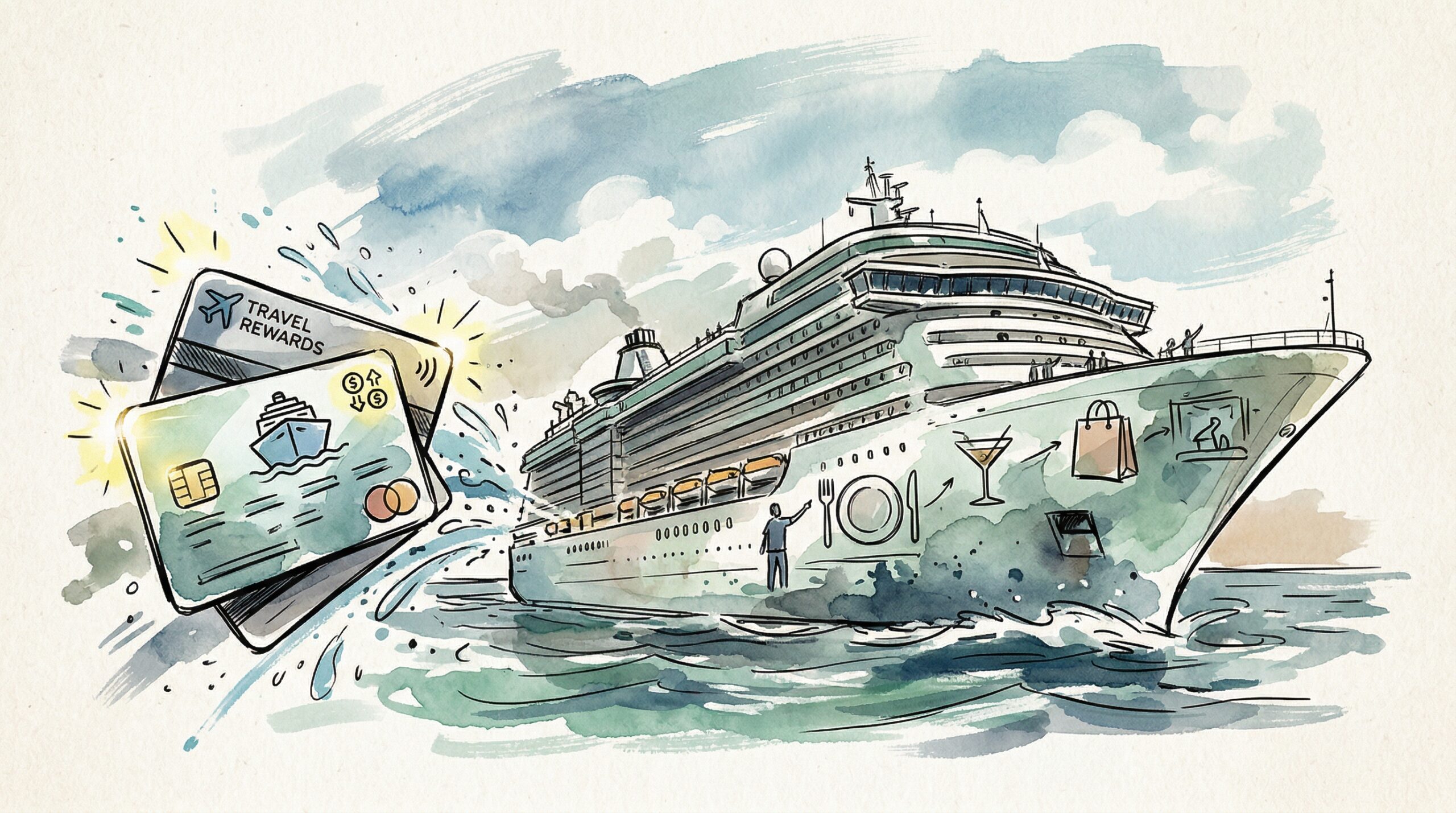

The Cruise Credit Card Playbook: Best Cards for Booking & Onboard Spending
Let’s get this straight: Cruise line co-branded credit cards are the red-headed stepchildren of the travel rewards ecosystem. They’re mediocre at best and downright misleading at worst. You’re better off with a general travel rewards card that allows you to spread your points across all your travel needs, not just that one cruise you booked in a moment of desperate escapism. Let’s dive deep into which cards make the cut and how you can use them to your lavish advantage.
General Travel Rewards Cards: The Best Bet for Most Cruisers
If you’re expecting that co-branded card from your fave cruise line to be your golden ticket to free cabins and unlimited piña coladas, I’m here to dash those dreams. General travel rewards cards are the MVPs when it comes to racking up points you can actually use.
Flexibility is Key
General travel rewards cards, such as the Chase Sapphire Preferred or the American Express Platinum, offer you something cruise line cards don’t: flexibility. You can transfer your points to airlines, hotels, and sometimes even straight to cruise lines. You’re not shackled to one company.
- Chase Sapphire Preferred: With a low annual fee and 2X points on travel and dining, this card punches above its weight. Its points transfer to major airline and hotel partners, giving you more ways to redeem your hard-earned points.
- Amex Platinum: This bad boy offers 5X points on flights booked directly with airlines or via Amex Travel. The annual fee is steep, but you’ll get VIP treatment with airport lounge access and hotel elite status. Plus, no foreign transaction fees.
Earning Points for Free Cruises
The holy grail of cruise hacking is, of course, the free cruise. The trick here is to strategically use your general travel rewards card to rack up enough points to cover those hefty cruise costs.
1. **Book flights and hotels for your cruise with your travel rewards card.** Earn those bonus points!
2. **Pay for onboard expenses like excursions and drinks.** Use the card’s lack of foreign transaction fees to your advantage.
3. **Transfer points to cruise line partners.** Some cards let you move points to cruise line loyalty programs, meaning you could cash in for some—or all—of your cruise fare.
The Co-Branded Cruise Card Trap
Co-branded cruise cards might offer you a welcome bonus that sings like a siren, but they often lead to choppy waters. These cards rarely offer the same versatility as a general travel card. Their points are often worth less and can only be redeemed through the cruise line.
Why They Fall Short
These cards usually offer minimal points per dollar spent unless you’re booking directly with the cruise line. That means your everyday spending isn’t going to get you much closer to that balcony suite.
- Lower Redemption Value: Points are often worth less when redeemed for non-cruise-related travel.
- Limited Bonus Categories: Unlike general cards, you’ll likely only earn extra points on cruise bookings.
- Lackluster Perks: Forget about airport lounge access or hotel upgrades; at best, you might get a free drink onboard.
When a Co-Branded Card Might Make Sense
Okay, it’s not all bad. If you’re cruising with the same line multiple times a year or live and breathe by their loyalty program, a co-branded card might be worth a look. But these scenarios are exceptions, not the rule.
Smart Strategies for Onboard Spending
Once you’re onboard, avoiding foreign transaction fees is a must. Here’s where your choice of credit card can save you a bundle. All the cards mentioned here waive these fees, meaning you’re not going to get hit with extra costs each time you buy a cocktail or book a shore excursion.
Use Points for Onboard Credits
Some travel rewards programs allow you to redeem points for onboard credits. This can be a lifesaver for offsetting the cost of drinks, specialty dining, and shore excursions. Check with your card issuer to see if this is an option.
Travel Insurance and Protections
Many top-tier travel rewards cards come with travel insurance and purchase protections. If you’re booking excursions or onboard experiences that come with hidden risks—or hidden costs—this protection can be invaluable. Always remember to read the fine print to know exactly what you’re covered for.
The Verdict: Which Cards Are Best?
For flexibility, earning potential, and perks, a premium travel rewards card is your best bet. Here’s a snapshot of why:
- More Ways to Earn: Earn bonus points on a wide variety of travel and everyday purchases.
- No Foreign Transaction Fees: Essential for making those onboard purchases without extra costs.
- Travel Protections: Comprehensive coverage options that cruise-specific cards typically lack.
For those set on a cruise card, just make sure you understand the limitations and ensure it aligns with your specific cruise patterns.
A Quick Recap
If only our on-shore lives allowed us the same choices that travel rewards cards do for our beloved cruise escapes. But alas, here’s your takeaway:
– **General Travel Rewards Cards:** More versatile, better perks, and the true heroes for cruising veterans.
– **Co-Branded Cards:** Mostly useful if you’re cruising with one line frequently (and I mean frequently).
– **Avoid Foreign Fees:** Pick cards that don’t charge these, saving you bucks for better onboard experiences.
– **Insurance is Key:** Use cards with travel insurance and purchase protections to keep your cruise stress-free.
Ready to dive into planning your next cruise with these cards in your arsenal? Check out our Cruise Line Dossiers for more insider info before you swipe that card. Bon voyage—and may your credit card points lead you to free cruises and endless sunsets on the open ocean!
What’s the best credit card for cruises?
The best credit card for cruises is the Chase Sapphire Preferred for most people, because it pays 5x when you book through Chase Travel and works on every part of the trip. It costs $95 a year. If you sail one line over and over, a cruise-line card can win on paper, but only if you accept the strings, and there are always strings. They’re the hidden buffet of credit cards: lots of options, and you only notice the catch after you’ve loaded your plate. These are the terms as of October 2026. Issuers change them constantly, so check the application page before you apply.
Last updated: October 22, 2026
| Card | Annual fee | Cruise earning | The catch |
|---|---|---|---|
| Chase Sapphire Preferred | $95 | 5x on Chase Travel bookings, 2x on other travel, 3x on dining | 75,000-point bonus needs $5,000 in 3 months |
| Capital One Venture Rewards | $95 | 2x on everything, cruises included | Flat rate, no bonus categories |
| Amex Platinum | $895 | 2x on cruises booked through Amex Travel, plus $100–$300 per cabin in onboard credit | Sailing must be 5+ nights and booked through Amex Travel |
| Royal ONE Plus Visa Signature | $99 | 4x on Royal Caribbean, Celebrity and Silversea | Points are worth about 1 cent, and only on those lines |
| Carnival Rewards Mastercard | $0 | 3x from the card, up to 6 points per dollar with Carnival Rewards’ own earnings | Points can’t be transferred and only work on Carnival |
Why the Sapphire Preferred wins
Let’s do some dramatic math, because nothing says “vacation” like a spreadsheet. Take a $4,000 cruise fare booked through Chase Travel. At 5x that’s 20,000 points, which comes to $200 if you value them at a flat 1 cent each. Chase says redemption values vary by reward option, so check what your points actually fetch at checkout. The same fare on Royal ONE Plus at 4x is 16,000 points, or about $160. On the free Royal ONE at 3x it’s 12,000 points, about $120. All of that assumes the whole $4,000 earns the bonus rate, and it may not: on the Carnival card, for example, The Points Guy reports that government taxes and fees don’t earn the extra points, so check your card’s terms before you count your points. The Sapphire’s points also work on flights to the port and hotels, and they transfer to 14 airline and hotel partners. Chase cut the World of Hyatt transfer ratio to 4:3 on this card in June 2026, which is a small blow, but nobody’s weeping into their welcome-aboard drink. It also charges no foreign transaction fees, and since June 2026 it includes a $100 annual Chase Travel hotel credit for your pre-cruise night.
Compare the Chase Travel price against booking direct before you commit. A 5x multiplier won’t save you if the fare is higher. Earning a mountain of points on an overpriced cabin is just paying extra for the privilege of feeling clever.
When a cruise-line card makes sense
Royal ONE Plus comes with a welcome offer of 60,000 points (Royal Caribbean values them at $600) after $2,500 in the first 90 days. For comparison, the Sapphire Preferred’s bonus is 75,000 points, though those are Chase points rather than Royal ones. The Royal card also gives a $200 cruise discount if you spend $20,000 in an anniversary year, which is a lot of Tuesdays at the grocery store. (Yes, I did the math on that. No, I’m not okay.) The no-fee Royal ONE gives 30,000 points after $1,500 and a $100 discount after $10,000.
Carnival’s card replaced the Carnival World Mastercard when Carnival Rewards launched September 1, 2026. It has no annual fee and a 50,000-point bonus after $1,000 in 90 days. The card itself earns 3x on Carnival purchases, and you can count up to 6 points per dollar once the program’s own earnings are included. Points are worth roughly 1 to 2 cents each, only on Carnival. That’s the catch: the points are a loyal little golden retriever, devoted to one ship line and utterly useless anywhere else. If you’re eyeing a Carnival Jubilee sailing from Galveston, that matters. If you’re sailing a Carnival ship once, it doesn’t.
The Amex Platinum is for a narrow crowd
At $895 a year, it’s a cruise card only if you already carry it. Nobody should be signing up for this one just to float. The $100–$300 per-cabin onboard credit needs a sailing of at least five nights booked through Amex Travel, like the 5-night Harmony of the Seas sailing. Book that sailing through Amex Travel and you earn 2x on it. Pay the cruise line directly, or book outside Amex Travel, and Amex says the extra point doesn’t apply. Read the fine print, then read it again.
Pick one in 30 seconds
- Cruise a few times a decade: Chase Sapphire Preferred.
- Want zero thinking: Capital One Venture Rewards, 2x on everything.
- Loyal to Royal Caribbean, Celebrity or Silversea: Royal ONE Plus, kept alongside a general travel card.
- Carnival devotee: the no-fee Carnival Rewards Mastercard.
Whatever you choose, check for foreign transaction fees before port day. Local shops and excursions priced in local currency are where a fee hurts, usually right as you’re haggling over a straw hat you absolutely do not need. The Sapphire Preferred, Royal ONE Plus and Carnival Rewards Mastercard charge none. Before you budget for any of this, see what a cruise really costs once you’re onboard.
Ships in This Story
- Harmony of the Seas Royal Caribbean · Latest CDC score 98
- Carnival Jubilee Carnival · Latest CDC score 100


Try our free cruise games & calculators
Explore real CDC inspection scores and outbreak data for every cruise ship.