


Last updated: October 14, 2026
Will the drink package actually save you money? Run your numbers through our Drink Package Calculator before you buy. Also check out our anti-overpacking cruise packing list.
The Big Booze Rundown
So, you’ve booked a cruise and you’re dreaming of sipping on something more potent than poolside mocktails. Before you try to stuff your suitcase with your favorite spirits, you need the lowdown on cruise alcohol policies. Spoiler: it’s not an open bar.
Cruise lines have a love-hate relationship with passenger booze. They want you sipping cocktails (from their bars, of course) but they’re not so keen on you bringing your own stash. Why? Money, honey. Alcohol sales are a cash cow for them. Let’s break down each major cruise line’s alcohol policy for 2026 so you don’t get caught with your, um, bottles down.
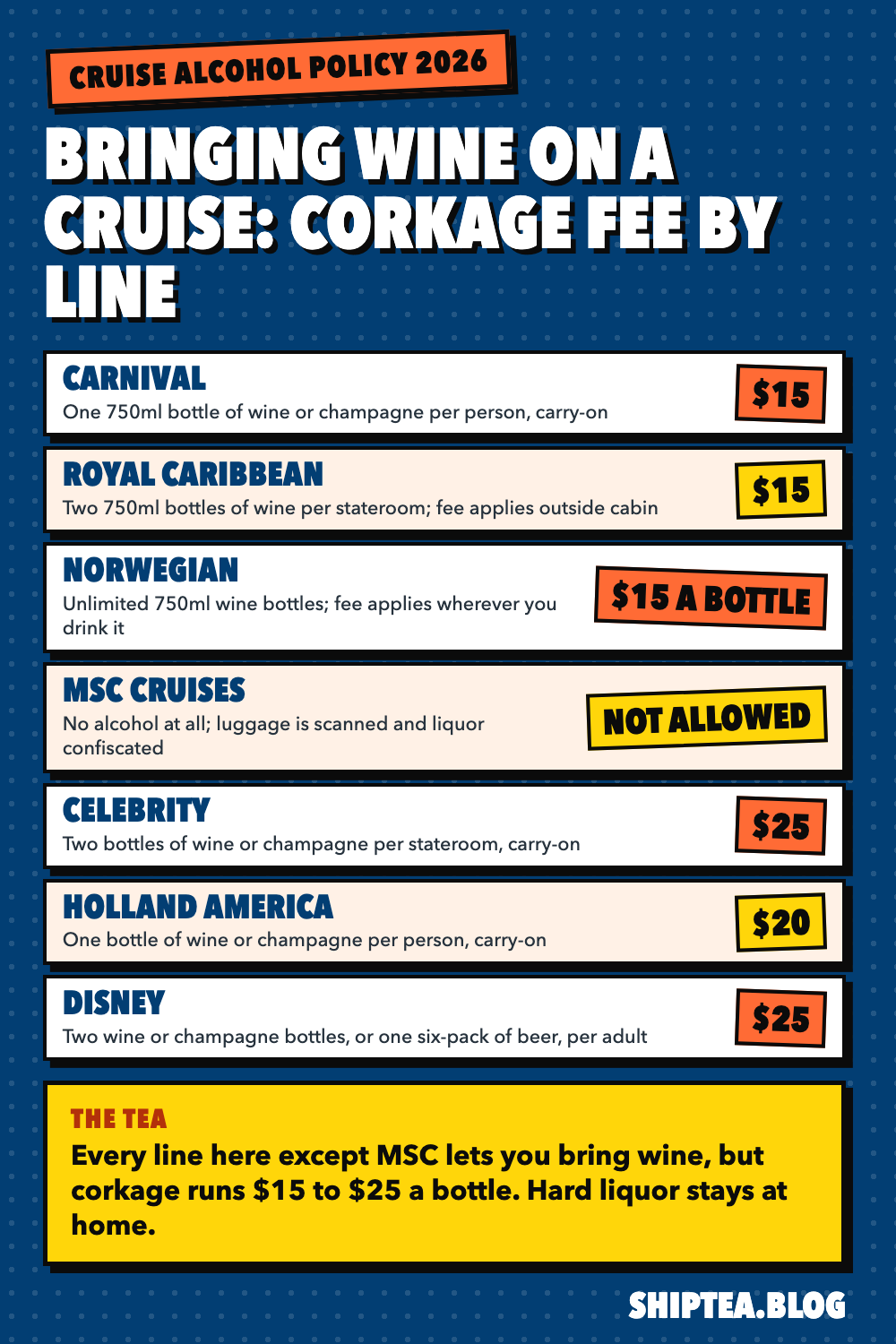
Cruise Line Alcohol Policies
Carnival Cruise Line
Carnival lets you bring up to *one* 750ml bottle of wine or champagne per person in your carry-on. Want to pop that cork at a dining venue? Prepare to fork over a $15 corkage fee. Don’t even think about sneaking in hard liquor or beer—Carnival’s security team can sniff out a rum runner like a bloodhound.
Royal Caribbean
Royal Caribbean’s policy is similar to Carnival’s: two 750ml bottles of wine per stateroom, but if you want to enjoy it outside your cabin, the corkage fee is $15. They’ve got the same zero-tolerance policy for hard liquor smuggling. Read more about Royal Caribbean’s policies.
Norwegian Cruise Line
Norwegian lets you bring an unlimited number of corkable 750ml bottles of wine, but with a sneaky twist: you’ll pay a $15 corkage fee per bottle no matter where you slurp it. This stings if you’ve ever been tempted by “free” wine. Hard liquor? Leave it to the professionals at Norwegian’s bars.
MSC Cruises
MSC Cruises isn’t the most vino-friendly. You can’t bring any alcohol on board—end of story. They double down on this by scanning luggage for liquor stowaways. If they catch you, it’s confiscation time.
Celebrity Cruises
Celebrity lets you bring two bottles of wine or champagne per stateroom in your carry-on. Corkage fees run you $25 if you want to bust open a bottle in the dining room. They’ve got no room for rum runners in their cabin plans.
Princess Cruises
Princess Cruises permits you one bottle of wine or champagne (up to 750ml) per adult in your carry-on. Extra bottles are welcome, but they’ll cost you $15 each in corkage fees. Don’t bother sneaking in vodka or whiskey—security’s on it.
Holland America Line
Holland America allows guests to bring one bottle of wine or Champagne per person in carry-on luggage. The corkage fee hits $20 per bottle if you want to sip it somewhere fancy like the dining room. Their security is legendary for stopping liquor smugglers, so tread lightly.
Disney Cruise Line
Disney’s policy is a pixie-dust version of strict: each adult can bring two bottles of wine or champagne (or one six-pack of beer) in their carry-on. Corkage fees are steep at $25. Given Disney’s squeaky-clean image, don’t expect them to turn a blind eye to rum-running.
What Happens If You Try to Sneak Alcohol?
Let’s cut to the chase: sneaking alcohol on a cruise is a gamble. If security catches you with undeclared booze, it gets confiscated, and you might get a stern talking-to. They might not throw you overboard, but you’ll be sipping on ginger ale while your stash languishes in security.
The Ultimate Rum Runner Debate
Ah, the infamous rum runner flask, beloved of crafty cruisers. These collapsible, easy-to-hide flasks are sold as the best way to sneak booze past security. But be warned: cruise lines are wise to this trick, and security is trained to spot them. Don’t underestimate a determined security team—they’re as serious as a pirate on payday.
Will the Real Corkage Fee Please Stand Up?
For all you wine lovers out there, corkage fees are the price of admission if you want to enjoy your own bottle without judgmental looks or staff side-eyes. These fees can range from $10 to $30 per bottle, depending on the cruise line. Here’s the kicker: you’ll pay this whether it’s your own bottle or one you bought on board. It’s a charge for the privilege of using their glassware and professional pourers.
Final Tips for Cruise Alcohol Policies
– **Understand the Rules**: Each cruise line’s alcohol policy is different. Double-check before you sail.
– **Stick to Wine and Champagne**: It’s the safest bet for bringing your own booze. Just remember those pesky corkage fees.
– **Don’t Push Your Luck**: Security isn’t messing around. Sneaking alcohol risks confiscation and potential embarrassment.
– **Consider Onboard Costs**: Sometimes it’s worth just paying for drinks on the ship. Check out the drink packages each line offers.
– **Use Our Resources**: For more on specific lines, visit their dossiers and make informed decisions.
With these insights, you’re equipped to navigate the boozy waters of cruise policies. Whether you’re a wine aficionado or a cocktail connoisseur, understanding these rules will keep you from making waves. Happy sailing—and sipping!
Safest Cruise Line: Does One Actually Exist?
Yes, we know you came here for corkage fees. But since you’re checking how safe your line is, here’s the straight answer: no cruise line wins “safest” across the board. Anyone who crowns one winner is selling something. Three public data sets show what you can compare, and what each one can’t tell you. (Spoiler: they all come with an asterisk the size of a lido deck.)
1. Sanitation: CDC inspection scores
The CDC’s Vessel Sanitation Program scores ships out of 100. A score of 86 or higher passes, and 85 or below fails. Ships get two unannounced inspections a year. In 2026, Norwegian Dawn scored 84 in March and failed. News coverage of the CDC’s 2026 scores, published in mid-August, also put Carnival Breeze, Kydon and National Geographic Sea Lion at exactly 86, the lowest passing mark. Carnival Breeze had also scored a perfect 100 earlier in the year. One line’s ship can go from flawless to barely passing within the same year, so a single score tells you about that day and that ship, not the whole company. Those are a snapshot from August, and ships get inspected again, so the newest scores may differ. Look up any ship in our CDC inspection lookup.
2. Outbreaks: who made the CDC list
The CDC’s 2026 outbreak page (updated July 23) listed nine outbreaks. That is a snapshot from the July 23 update. The CDC may have added more since, so check the page for the current list. The CDC posts an outbreak when 3% or more of passengers or crew report gastrointestinal illness.
- Lindblad Expeditions: four, all on National Geographic Sea Bird
- Princess Cruises: three (Star Princess, Caribbean Princess, Ruby Princess)
- Oceania Cruises: one (Insignia, E. coli)
- Regent Seven Seas: one (Seven Seas Mariner, E. coli)
The CDC’s table doesn’t list case counts for most of these outbreaks. The tallies above show how many outbreaks were posted, not how many people got sick. The one we can size up is Caribbean Princess (April 28 to May 11): 145 of 3,116 passengers and 15 of 1,131 crew got sick, which is 160 of 4,247 people aboard. The caveat is that counting outbreaks by line ignores fleet size. The CDC list doesn’t say how many sailings or passengers each line carried, so these counts can’t be turned into a fair rate. Big mass-market lines run far more sailings, and a tiny expedition ship with four outbreaks is a different story from a megaship with one. Treat the headline counts as a conversation starter, not a leaderboard.
3. Crime: the Department of Transportation numbers
Under U.S. law, lines must report certain crimes. The Department of Transportation’s latest compilation, published in August 2026, covers April 1 to June 30, 2026 (Q2). It lists 50 incidents. Carnival reported 20, MSC 9, Royal Caribbean 7 and Norwegian 6. Margaritaville at Sea and Celebrity reported 2 each. Virgin Voyages, Disney, Holland America and Princess reported 1 each. Of the 50, 44 were sexual offenses (25 rape and 19 sexual assault). For comparison, Q1 2026 (January to March) had 43, led by Royal Caribbean with 14 and Carnival with 11. That makes 93 for the first half of the year.
One date quirk: DOT counts incidents by the quarter they were reported to the FBI, not the quarter they happened. A “Q2” incident may have happened earlier. These are raw counts, not rates per passenger, so the biggest fleets tend to land high on the list. Physical assaults only count if they cause serious injury, so treat the numbers as a floor.
So how do you pick?
- Sailing with young kids or a fragile stomach? Check the specific ship’s latest score and recent outbreak history, not the brand.
- Traveling with allergies? Policies vary by line. Start with our cruise food allergies guide.
- Traveling with older relatives? Medical facilities and accessibility matter more than any ranking. See best cruise for seniors.
Bottom line: Pick the ship, not the logo. Check its CDC score and recent outbreak record. Then pack hand sanitizer and wash your hands like a surgeon, because norovirus doesn’t care what flag you sail under.
Ships in This Story
- Caribbean Princess Princess · Latest CDC score 93
- Ruby Princess Princess · Latest CDC score 98
- Seven Seas Mariner Regent Seven Seas · Latest CDC score 93
- National Geographic Sea Bird Lindblad · Latest CDC score 86
- Norwegian Dawn Norwegian · Latest CDC score 84
- Carnival Breeze Carnival · Latest CDC score 86

Try our free cruise games & calculators
Explore real CDC inspection scores and outbreak data for every cruise ship.