
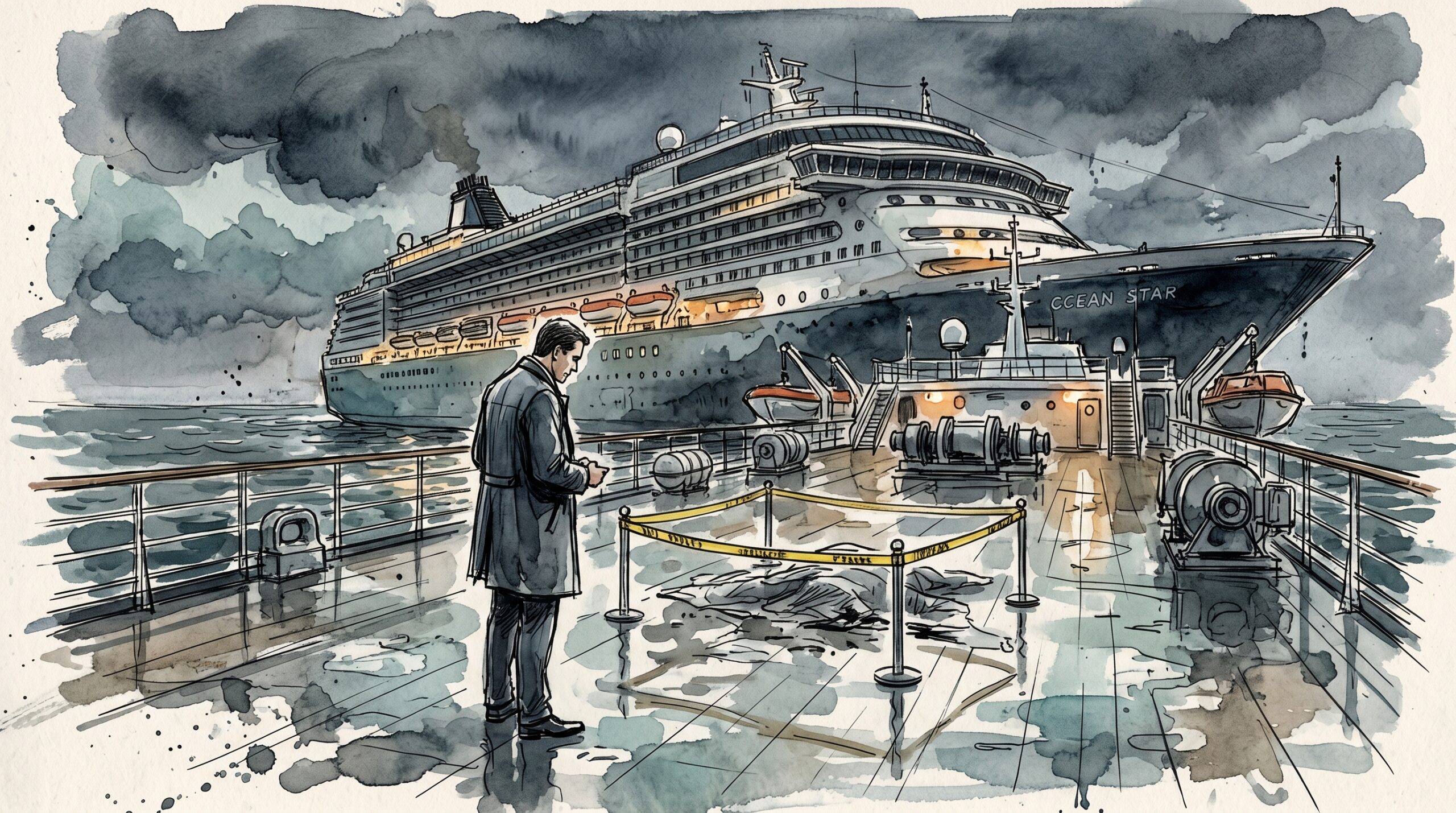

When the FBI gets involved, it means someone decided this wasn’t an accident. Let that sink in.
Tea TempLast updated: May 25, 2026
Federal agents have launched a formal investigation into the death of a passenger aboard a Carnival cruise ship. Not local authorities. Not the cruise line’s own “safety team” — which, let’s be honest, has the same energy as a bank investigating its own fraud. The FBI. The same people who handle terrorism, organized crime, and the stuff that’s too serious for anyone else to touch.
Why the FBI? That’s the Question.
Here’s what you need to understand about federal jurisdiction on cruise ships: it doesn’t happen automatically. The FBI doesn’t just show up because someone died at sea. Deaths on cruise ships — and there are more than the industry would like you to Google — are typically handled by the cruise line, maybe local authorities at a port of call, maybe the flag state of the ship. It’s a jurisdictional patchwork that has historically allowed a lot of uncomfortable situations to be quietly filed under “natural causes” and sent home in a box.
Federal involvement changes that math entirely. When the FBI opens a formal probe, it’s because there’s a reasonable basis to believe a federal crime may have been committed. That could mean a death that occurred in U.S. waters or involved U.S. nationals in a way that triggers federal statutes. It could mean evidence of foul play. It could mean the circumstances were suspicious enough that someone, somewhere, made a call — and that call went all the way up.
Carnival’s Track Record Isn’t Exactly Comforting Here
We’re not going to pile on Carnival just because the FBI is investigating one of their ships. That would be unfair. But it would also be irresponsible not to mention that Carnival Corporation — the parent company — has had a complicated relationship with passenger safety for a very long time. The fleet is massive, the ships carry thousands of people at a time, and statistically, things are going to happen.
The question has always been: what happens after things happen? Are incidents investigated thoroughly? Are passengers and their families given honest answers? Is the cruise line’s interest in reputation management ever allowed to crowd out the pursuit of truth?
An FBI investigation is, in a dark way, a form of accountability. It means those questions can’t be quietly managed by a PR department.
What We Don’t Know (And Why That’s Frustrating)
Here’s the uncomfortable part: details are scarce. We don’t know the passenger’s name. We don’t know which Carnival ship was involved. We don’t know what circumstances led investigators to federal involvement — whether this happened at sea, at a port, or during what part of the voyage.
That opacity is, unfortunately, kind of standard operating procedure for early-stage federal investigations. The FBI doesn’t hold a press conference to announce they’re looking into something. They get quietly to work. Information comes out in fragments, sometimes over months.
For the family of the person who died, that silence must be excruciating. You lose someone on what was supposed to be a vacation — a celebration, maybe, or a long-awaited trip — and then you wait while investigators piece together what actually happened.
The Cruise Industry’s Uncomfortable Reality
Cruise ships occupy a strange legal gray zone. They sail under foreign flags, they cross international waters, they dock in multiple countries on a single voyage. Passengers often have no idea how limited their legal protections are compared to, say, a hotel or an airline. The Cruise Vessel Security and Safety Act of 2010 exists specifically because Congress looked at how cruise lines were handling crimes at sea — including deaths — and decided that something had to change.
That law requires cruise lines to report crimes to the FBI. It requires the preservation of evidence. It requires access for law enforcement. It was a direct response to cases where passengers died or were assaulted and the cruise line’s cooperation with investigators was… let’s say, less than enthusiastic.
So when the FBI steps in, they have legal authority. And Carnival — whatever their internal preferences might be — has to cooperate.
If you want to know more about how a specific Carnival ship stacks up on safety and compliance, you can look up any ship’s report card — it won’t tell you anything about this investigation, but it’s a starting point for understanding what these vessels look like on paper.
What We Know
- Ship: A Carnival cruise ship (specific vessel not yet confirmed)
- What happened: A passenger died aboard the ship
- Who’s investigating: The FBI has opened a formal investigation
- Why it matters: Federal involvement signals the death is being treated as potentially criminal, not accidental or natural causes
- Passenger identity: Not yet publicly disclosed
- Circumstances: Not yet publicly disclosed
- Outcome: Investigation ongoing
We’ll be watching this one. When the FBI is involved, answers tend to eventually surface — even if it takes longer than anyone wants. The family of whoever died deserves those answers. And frankly, so does anyone who’s ever booked a cruise and assumed that “what happens at sea” would be handled with the same seriousness as anything that happens on land.
It should be. It doesn’t always work out that way. But this time, at least, the people with badges and subpoena power are paying attention.

Try our free cruise games & calculators
Explore real CDC inspection scores and outbreak data for every cruise ship.