
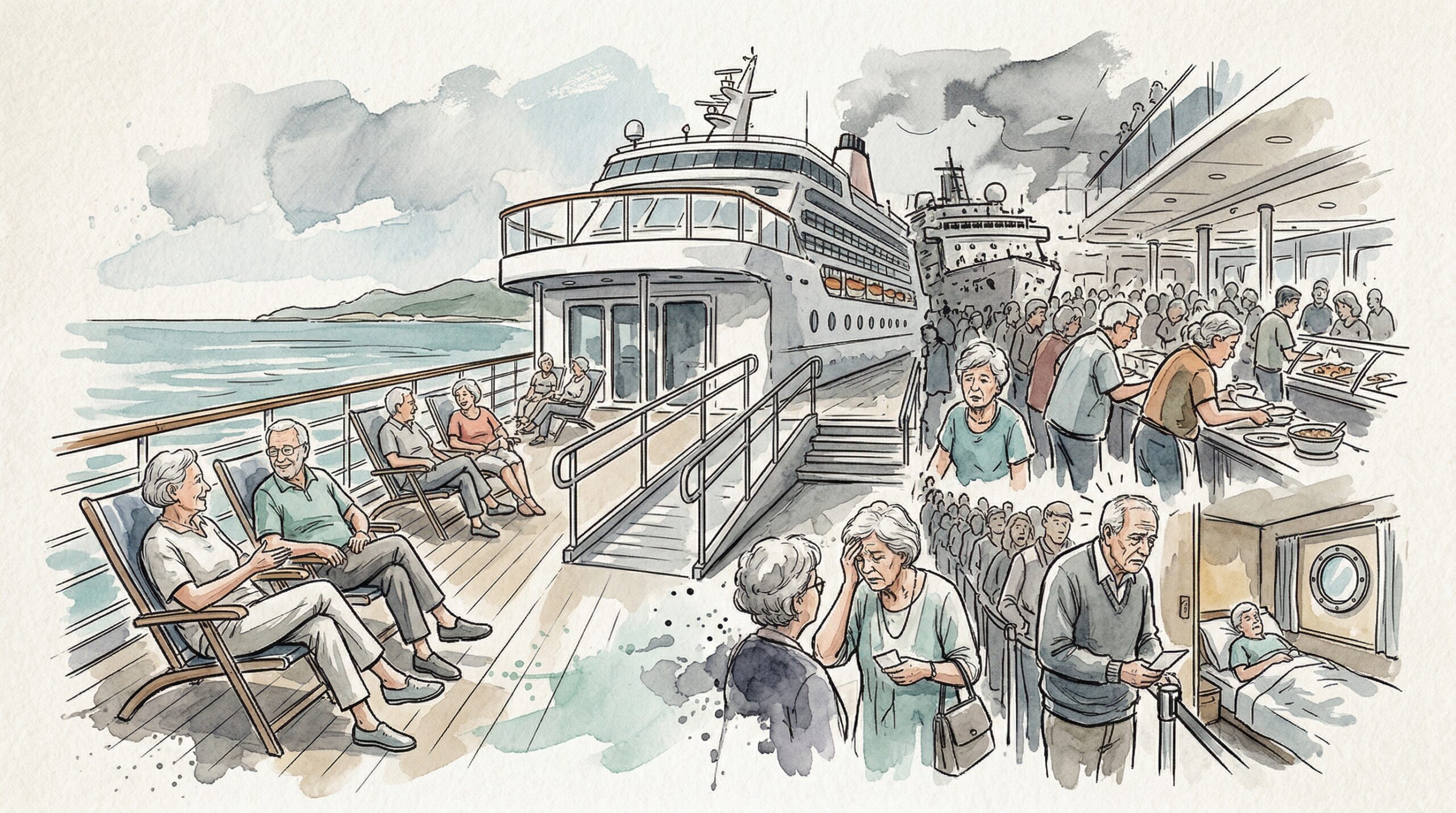

If you want a genuinely easy first cruise built around people your own age, book Holland America’s Koningsdam or Zuiderdam on a 7-night Caribbean or Alaska sailing for roughly $1,200–$1,900 per person in a veranda stateroom. Koningsdam posted a perfect 100/100 on its most recent CDC inspection — you can check it yourself in our cleanest cruise ships database — and Holland America’s passenger base skews older than almost any mainstream line, so nobody’s dodging a foam party at 2pm.
Last updated: September 7, 2026
If mobility is the priority over price, Viking Ocean is the strongest pick: every stateroom fleet-wide has a veranda and a genuinely accessible bathroom layout, the fleet is 18-and-over, and 7 nights runs roughly $3,000–$3,600 per person with shore excursions included. And if the top requirement is “never rush,” Cunard’s longer Atlantic crossings and world-voyage segments on Queen Mary 2 or Queen Anne give you 2–4 sea days between ports instead of the back-to-back sprint most Caribbean itineraries force on you.
Most “best cruise for seniors” articles just repeat the same three lines (Holland America, Viking, Oceania) without saying why, and skip the two things that actually matter most: whether the ship’s medical facility can handle a real emergency, and what an accessible cabin actually costs versus a standard one. We track ship-level sanitation and crew-treatment data specifically because those are the two things a glossy brochure won’t tell you. Here’s the real breakdown.
Quick-Reference Best Cruise for Seniors Table
Skip to the 2026 Update | Skip to FAQ
| Cruise Line | Best For | 7-Night Price (pp) | What Makes It Work | The Catch |
|---|---|---|---|---|
| Holland America (Koningsdam, Zuiderdam) | First-time senior cruisers who want a same-age crowd, not luxury pricing | $1,200–$1,900 | 100/100 CDC score on Koningsdam; deep accessible-cabin inventory | Entertainment skews sedate; smaller ships mean fewer dining venues |
| Viking Ocean | Mobility-focused travelers who need guaranteed accessibility | $3,000–$3,600 | Every stateroom has a veranda; fleet-wide wheelchair access; 18+ means no running kids | Lowest crew-treatment score we track (63/100) despite a polished guest experience |
| Oceania | Foodie seniors who want smaller ships and slower port days | $3,000–$3,800 | Ships cap near 1,200–1,250 passengers; easy, walkable layout | Fewer dedicated accessible cabins than big-ship lines; itineraries still port-heavy |
| Regent Seven Seas / Silversea | Seniors who want zero decision fatigue — everything included | $5,000–$6,500+ | Unlimited included shore excursions; Regent’s crew-treatment score (83/100) is #2 industrywide; all-suite means no long hallway walks | The price, and a smaller onboard medical bay than mega-ships carry |
| Princess | Seniors already loyal to a familiar mainstream brand | $1,300–$1,800 balcony | Wide accessible-cabin count fleet-wide; calmer daytime programming than Carnival or Royal Caribbean | Newest ships bundle a mandatory $105/day Princess Premier package into Sanctuary bookings |
| Cunard (Queen Mary 2, Queen Anne) | Widowed or solo seniors who want built-in social structure | $2,600–$3,400 | Vetted “gentlemen hosts” as dance partners and dinner companions on longer voyages | Formal nights are frequent; the average age can feel institutional to some |
| Norwegian | Seniors cruising with adult kids or grandkids who still want accessibility | $1,400–$2,000 balcony | Prima-class ships have newer accessible pools with gradual-entry slopes, not just lifts | Freestyle Cruising means less structured routine; ships skew larger and busier |
| Carnival / Royal Caribbean mega-ships | Nobody who wants a quiet trip | $700–$1,100 | Cheapest fares in the industry | Icon-class and similar ships are built around waterparks; longest walk from cabin to dining room of any ship class |
For a full line-by-line breakdown, see our Cruise Line Dossiers.
The 2026 Shift: Insurance Costs Spike, Accessible Cabins Vanish Faster
Two things changed for senior cruisers heading into 2026 that most guides haven’t caught up to yet. First, Squaremouth’s 2026 Cruise Insurance Cost Report found that travelers over 70 now pay 311% more for cruise travel insurance than travelers under 50 — a direct result of medical evacuation coverage getting more expensive as claims rise. Budget for it as a real line item, not an afterthought: a $200,000–$250,000 medical evacuation limit is the number insurance brokers actually recommend for a senior sailing internationally, and it’s not optional the way it might feel on a domestic land vacation.
Second, accessible cabins are now selling out 12–18 months in advance on the most popular senior-friendly ships, driven by rising demand and a limited supply per ship (usually under 30 fully accessible staterooms even on a large vessel). If you’re eyeing a 2026 or 2027 Alaska or Mediterranean sailing and need a roll-in shower or a wider doorway, book now — waiting until 90 days out means the accessible inventory is already gone, full stop.
On the ship side, Royal Caribbean’s Legend of the Seas — the line’s third Icon-class ship, debuting in 2026 and repositioning to Fort Lauderdale for winter Caribbean sailings — is worth naming as the ship to skip if you’re a senior shopping by price alone. It carries 5,610 passengers and is built around the largest waterpark at sea; long corridors, big crowds at the elevators, and a family-first layout make it a genuinely poor fit regardless of how cheap the fare looks.
Mobility and Accessibility Realities, Ship by Ship
“Wheelchair accessible” means something different on every ship, and the differences matter. Royal Caribbean builds fully ADA-certified staterooms into its newer ships and even its private island, CocoCay, has beach wheelchairs and pool lifts — but you’re navigating a 5,000-plus-passenger crowd to use any of it. Holland America and Princess both carry deep accessible-cabin inventories because their guest base skews older, but that demand means those cabins book up first. Norwegian’s newer Prima-class ships added gradual-entry pool slopes alongside traditional lifts — a real upgrade over older ships that only offer a mechanical lift and nothing else. Viking Ocean is the simplest answer: the entire fleet was designed accessible from the keel up, so there’s no gamble on which cabin category or which specific ship you land on.
- General rule: the newer the ship, the more accessible it tends to be, and larger ships have more total accessible cabins even if the ratio per passenger isn’t better.
- Book early: accessible cabins are a fixed, small inventory (often under 30 per ship) and the popular sailings sell out 12–18 months ahead.
- Ask specifics: “accessible” can mean a roll-in shower and grab bars, or just a slightly wider door. Confirm exactly what’s in the cabin before booking, not after.
Medical Facilities at Sea: What to Actually Check
Every major cruise ship carries an onboard medical center with at least one physician and several nurses, basic diagnostic equipment, and telemedicine links to shore-based specialists. What most seniors don’t realize: Medicare does not cover medical care on a cruise ship, even in U.S. territorial waters, and it never covers medical evacuation. Onboard doctor visits are billed directly to your onboard account like a specialty restaurant, often $100–$200 for a basic consultation. This is exactly why the insurance shift above matters — a real travel insurance policy with medical evacuation coverage isn’t a nice-to-have for a senior cruiser, it’s the only thing standing between a shipboard emergency and a bill that starts with a comma.
Longer Itineraries and Slower Pacing
A back-to-back port schedule with a new island every single day sounds efficient but is exhausting — you’re packing and unpacking your energy level daily instead of settling into the trip. Look for:
- A healthy ratio of sea days: at least one full day at sea for every two or three port days, so there’s real recovery time built in.
- Overnight port stays: instead of a rushed 8-hour call, an overnight stay lets you see a city without racing the “all aboard” clock.
- Slower-cruising itineraries: Cunard’s transatlantic crossings and Viking’s and Oceania’s Mediterranean routes are built around fewer, longer port visits rather than a checklist of quick stops.
Single-Supplement Realities for Widowed and Solo Seniors
The cruise industry still prices fares “per person, double occupancy,” which means a solo cruiser — including a recently widowed traveler booking their first trip alone — often pays a 50–100% single supplement on top of the base fare. A few lines have built real alternatives: Holland America’s Solo Singles program discounts the supplement and organizes meet-ups aimed at an older solo crowd, and Norwegian’s Studio cabins (on Epic, Bliss, Encore, and several other ships) carry zero single supplement at all, though they’re compact at around 100 square feet. Cunard goes a different direction with vetted “gentlemen hosts” who serve as dance partners and dinner companions for solo women on longer voyages — an old-fashioned solution, but one that specifically targets widowed and solo older travelers rather than treating them as an afterthought. For the full line-by-line supplement breakdown, see our Solo Cruise Guide 2026.
Which Lines Skew to Which Age Profile
If cruising with people your own age matters to you, the average passenger age varies more between lines than almost any other factor. Holland America and Cunard both skew older — comfortably into the 60s and 70s on most sailings. Oceania, Regent Seven Seas, Silversea, and Viking Ocean draw a similar age range but with a higher household income, which shows up in pricing rather than pacing. Princess and Norwegian sit in the middle, mixing families, multi-generational groups, and older couples depending on the specific itinerary and season. Carnival and Royal Caribbean skew younger and more family-heavy across the board, especially on Caribbean sailings during school breaks — check our dress code guide by line if you’re weighing Cunard’s more formal culture against a more casual mainstream line,.
Whatever line you land on, budget properly for the crew who’ll be doing the actual physical work of your trip — carrying luggage, managing mobility equipment, and making repeat trips to your cabin. Our cruise ship tipping guide breaks down exactly who gets what and when a little extra cash is appropriate for above-and-beyond help.
FAQ: Best Cruise for Seniors
What are the best ocean cruises for seniors?
Holland America, Viking Ocean, Oceania, and Cunard are consistently the strongest choices for senior cruisers because their passenger base skews older, their pacing is slower, and their accessible-cabin inventory is deeper than mainstream family lines. Holland America is the best value entry point; Viking Ocean is the best choice specifically for guaranteed mobility access.
What is the best cruise line for seniors with mobility issues?
Viking Ocean is the strongest option because every stateroom fleet-wide was built accessible from the start, rather than a limited number of retrofitted cabins. Holland America and Princess also carry large accessible-cabin inventories, but those cabins book up 12–18 months ahead, so early booking matters more than the line you pick.
Which cruise lines have the most accessible cabins?
Holland America and Princess carry the deepest accessible-cabin inventories among mainstream lines, partly because their older passenger base drives more demand for them. Royal Caribbean’s newer ships have fully ADA-certified staterooms, and Norwegian’s Prima-class ships added gradual-entry accessible pool designs. Viking Ocean’s entire fleet is accessible by design rather than by cabin category.
Do cruise ships have doctors and medical facilities onboard?
Yes, every major cruise ship carries an onboard medical center with at least one physician, several nurses, and telemedicine access to shore-based specialists. However, Medicare does not cover cruise ship medical care or medical evacuation, and onboard doctor visits are billed directly to your account — often $100–$200 for a basic consultation.
What is the best cruise for a senior traveling alone?
Holland America’s Solo Singles program and Norwegian’s Studio cabins (with zero single supplement) are the two strongest options for a solo senior. Cunard’s transatlantic crossings, which include vetted “gentlemen hosts” as dinner and dance companions, are specifically built around widowed and solo older travelers rather than younger backpacker-style solo cruising.
Which cruise lines should seniors avoid?
Mega-ships like Royal Caribbean’s Icon-class (including the new Legend of the Seas) and MSC’s World-class ships are the weakest fit — they’re built around waterparks and family activities, involve long walks between the cabin and dining venues, and carry 5,000 or more passengers, which makes basic navigation harder for anyone with mobility limitations.
Do seniors need travel insurance for a cruise?
Yes. Medicare doesn’t cover any medical care at sea, and cruise insurance costs for travelers over 70 rose to roughly 311% more than travelers under 50 in 2026 due to rising medical evacuation claims. A policy with $200,000–$250,000 in medical evacuation coverage is the standard recommendation for senior cruisers sailing internationally.
The Bottom Line
For most first-time senior cruisers, Holland America is the safest starting point — a same-age crowd, a deep accessible-cabin inventory, and CDC scores (Koningsdam’s perfect 100/100 among them) that back up the line’s reputation for a well-run ship. If mobility access is non-negotiable rather than a nice-to-have, skip straight to Viking Ocean, where accessibility isn’t a cabin category to hunt for but a fleet-wide design choice.
Whichever line you choose, treat the two 2026-specific realities in this guide as non-negotiable: buy real travel insurance with a genuine medical evacuation limit, because Medicare stops at the gangway, and book any accessible cabin the moment your dates are set, because the popular ships are already selling that inventory 12 to 18 months out. Skip the mega-ships built around waterparks and school-break crowds — check the specific ship’s inspection score before you book, since the cruise line name tells you the vibe but not what you’re actually walking onto.


Try our free cruise games & calculators
Explore real CDC inspection scores and outbreak data for every cruise ship.