
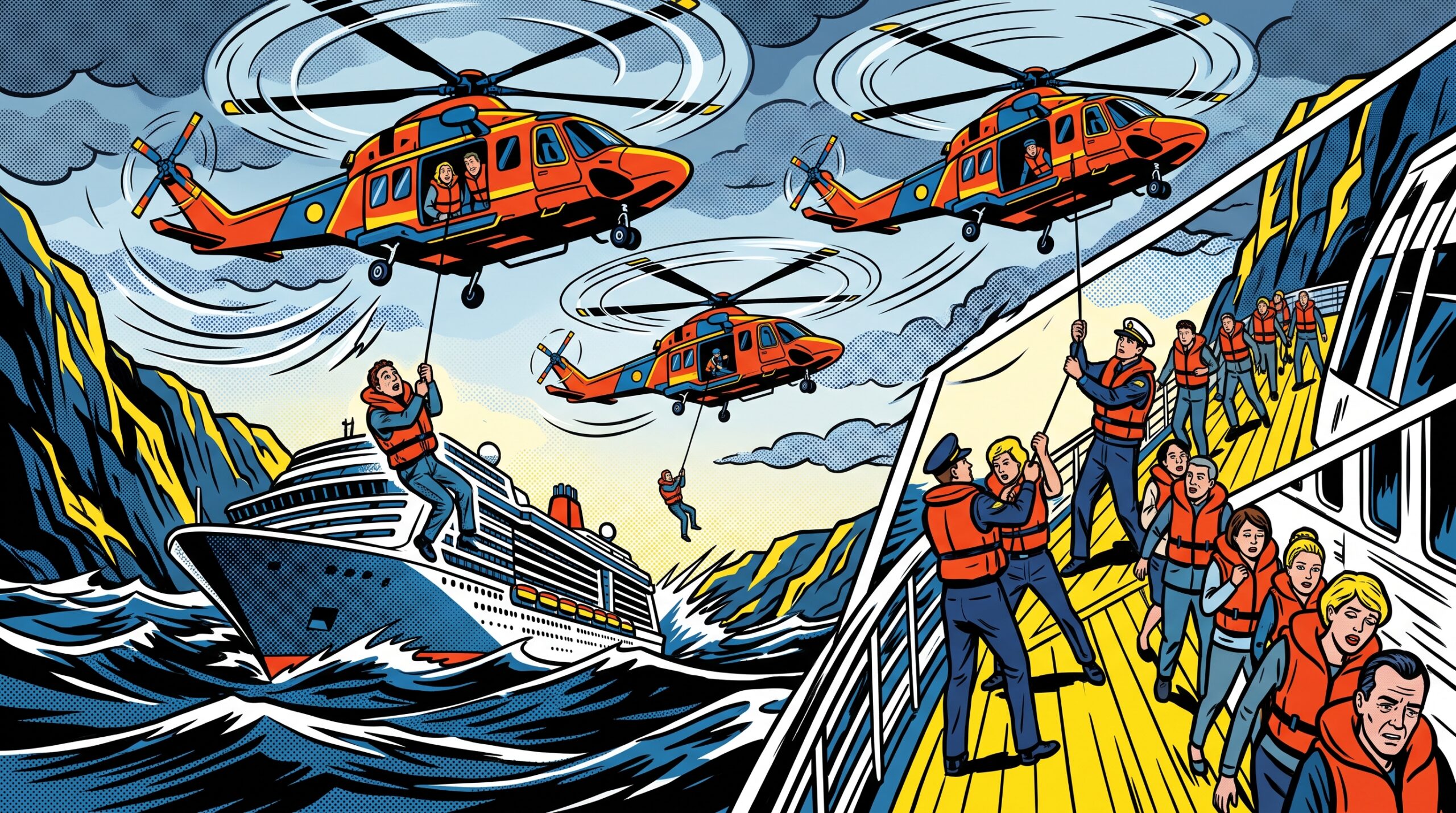

Nearly 400 people spent part of their cruise dangling from a cable over the Norwegian Sea. Not the shore excursion anyone signs up for — but it beat the alternative.
Tea TempLast updated: August 5, 2026
A cruise liner became stricken off the coast of Norway, and what followed was a large-scale rescue operation that pulled almost 400 passengers and crew off the ship, winched to safety one by one. Read that again: almost 400 people. That’s not a lifeboat drill — that’s an all-hands, multi-agency, hope-the-weather-holds emergency response.
What “Stricken” Actually Means Here
“Stricken” is one of those words that sounds almost old-fashioned until it’s your ship. It means the vessel lost the ability to operate safely under its own power or control — and off the Norwegian coast, that is not a place you want to be stuck. Norway’s coastline is gorgeous on a brochure and absolutely unforgiving in an emergency: cold water, exposed cliffs, and weather that can turn a routine sailing into a crisis within the hour.
When a ship that size can’t be trusted to hold position or steer, evacuating by helicopter — one winch, one person, one rescue swimmer at a time — becomes the safer bet over waiting it out at sea. That should tell you everything about how seriously responders treated this.
The Winch-By-Winch Math
Almost 400 people. One at a time, or in small groups, hoisted off a moving, unstable ship into a hovering aircraft. That’s not a quick job — it’s hours of coordinated, high-stakes flying, repeated again and again until every last person is accounted for. Every single lift is its own small emergency: wind, wave motion, the ship’s own instability all working against the crew doing the hoisting.
Crew were among those brought off too, not just passengers. Worth sitting with for a second — the people running toward the problem, keeping the ship as steady as possible for everyone else, off last if at all standard practice is followed. If you’ve ever wondered how cruise lines treat their crew when things go sideways, moments like this are the real test, not the marketing copy.
Why This Is a Bigger Deal Than a “Delay”
Cruise incidents get flattened into PR language constantly — “itinerary change,” “operational issue,” “unscheduled deviation.” None of those phrases involve a helicopter winch. A rescue operation of this scale means someone, somewhere, made the call that staying aboard was riskier than a hours-long air evacuation off a coastline. That’s not a delay. That’s a maritime emergency, full stop.
We don’t yet have confirmation on the ship’s name, the exact date, or what caused it to become stricken in the first place — the reporting so far is thin on specifics, and we’re not going to invent details to fill the gaps. What we do know is the scale of the response, and that alone puts this near the top of this year’s “things that actually went wrong on a cruise” list.
What Happens Next
Expect an investigation into what left the ship unable to operate safely, likely involving Norwegian maritime authorities and the cruise line’s own incident review. Expect, too, a very careful press statement that uses the word “precaution” a lot. We’ll update as more solid details surface — but the headline fact doesn’t need embellishing: almost 400 people had to be winched off a cruise ship at sea. That’s the story.
What We Know
- Ship: Not yet identified in initial reporting
- Date: Not specified in initial reporting
- Location: Off the coast of Norway
- What happened: The cruise liner became stricken, triggering a large-scale rescue operation
- Injuries: None reported at this time
- Outcome: Almost 400 passengers and crew winched to safety, reportedly by helicopter
Try our free cruise games & calculators
Explore real CDC inspection scores and outbreak data for every cruise ship.