
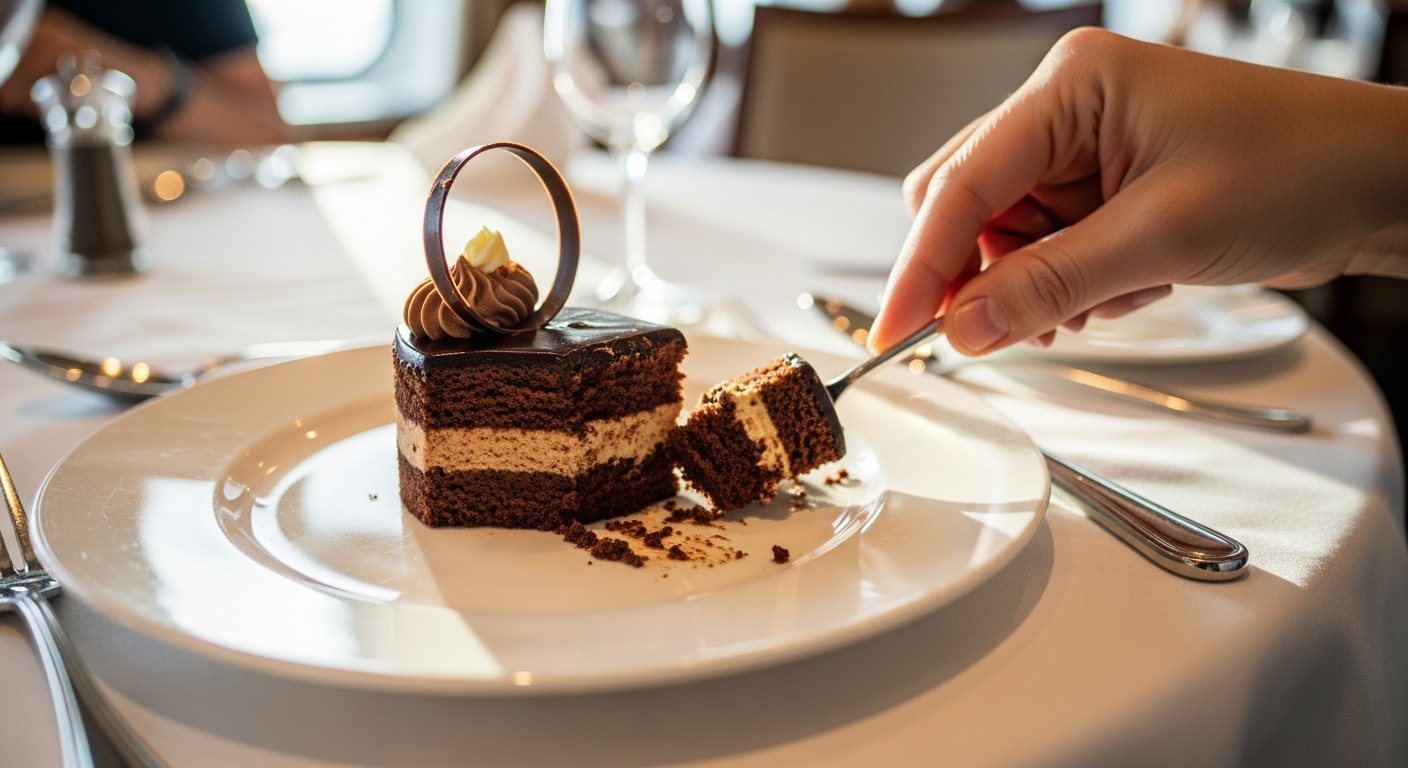

Let’s have an honest conversation. Not the kind of honest where you tell yourself you’ll “eat light” and “hit the gym on the ship” and “mostly stick to grilled fish.” The REAL kind of honest. The kind where you admit that the midnight pizza station is going to see you every single night at 11:47 PM in your bathrobe.
Because here’s the thing about cruise ships: they are purpose-built calorie delivery systems. The buffet alone has more food than some restaurants serve in a week, and it’s open approximately always. There’s 24-hour room service. Soft serve machines that never close. Specialty restaurants you “have” to try because you already paid for the dining package. And someone is always, ALWAYS walking around with a tray of something.
This is not a judgment-free zone. This is a math zone.
The Average Cruise Weight Gain (It’s Not What You Think)
Most sources will tell you the average cruiser gains about 1-2 pounds per day of their cruise. A 7-night cruise? That’s 7-14 pounds. Except that number is misleading, because it includes the fitness people who actually use the ship’s gym (both of them) AND the person who went back to the buffet four times at lunch.
Your actual weight gain depends on a cocktail of factors that are unique to you:
- How long is your cruise? A 3-night Bahamas run is damage-containable. A 14-night Mediterranean sailing is a different beast entirely.
- What’s your eating style? There’s a spectrum from “I’ll have the salad” to “one of everything, please” and most of us land closer to the buffet end than we’d like to admit.
- Are you drinking? Alcohol calories are the invisible enemy. A frozen drink by the pool is 300-500 calories of pure tropical deception. (And if you bought the drink package, you’re DEFINITELY getting your money’s worth.)
- Activity level? Some cruisers hike at every port. Others consider walking to the buffet cardiovascular exercise. Both are valid life choices with very different caloric outcomes.
The Buffet Factor
Cruise ship buffets are an engineering marvel of temptation. They’re designed by people who understand human psychology better than most therapists. The dessert station is always RIGHT THERE when you’re getting your coffee. The carving station has a chef standing there looking at you expectantly. And everything is “free” (already paid for, but your brain doesn’t process it that way).
Studies show that people eat significantly more when presented with a wider variety of foods. It’s called the “buffet effect” or “sensory-specific satiety” if you want to sound smart at the captain’s dinner. Basically, you’re full of pasta but your stomach somehow has a completely separate compartment for that chocolate lava cake.
The Drink Calories Nobody Counts
A piña colada: ~500 calories. A strawberry daiquiri: ~300 calories. A “light” beer: 100 calories. That bottle of wine you split with your partner at dinner: 300 calories each.
If you’re having 4-5 drinks a day (which is pretty standard cruise behavior, especially if you have a drink package), you’re adding 1,000-2,000 liquid calories on top of everything you ate. Your body processes these the same way it processes food, despite your brain’s insistence that “drinks don’t count.”
Drinks count. They count SO HARD.
What About the Ship’s Gym?
Yes, most cruise ships have gyms. Some are actually quite nice. The views from the treadmill are unbeatable. But here’s the math that hurts: a 45-minute run burns roughly 400-500 calories. That’s one dessert. One. You ate four.
Exercise on a cruise is great for your mental health and for maintaining muscle, but it’s not going to outrun (literally) the caloric onslaught of unlimited food and drink. You cannot exercise your way out of the midnight pizza problem.
So How Much Will YOU Gain?
This is where it gets personal. We built a Cruise Weight Gain Calculator that gives you a real (and entertainingly honest) estimate based on:
- Your cruise length
- Your eating habits (be honest!)
- Your drinking habits (be REALLY honest)
- Your activity level
- Whether you’ll actually use the gym (statistically, you won’t)
It’ll give you a projected weight gain in pounds, plus some fun comparisons to put that number in perspective. Like how many lobster tails that weight is equivalent to. Or how many laps around the promenade deck it would take to burn it off. Spoiler: it’s a lot of laps.
Tips for Damage Control (If You Care)
The Realistic Approach
Don’t try to diet on a cruise. That’s a waste of money and willpower. Instead, make small adjustments: skip the bread basket at dinner, choose one dessert instead of three, and actually walk to the pool instead of taking the elevator. Small wins.
The “I’m on Vacation” Approach
Eat what you want, drink what you want, enjoy every minute, and deal with the scale when you get home. This is the approach 90% of cruisers take, and honestly? There’s something to be said for fully committing to the experience.
The Strategic Approach
Eat a lighter breakfast, go big at lunch (your most active digestion hours), have a reasonable dinner, and save your indulgences for the specialty restaurants where the food is actually worth the calories. Skip the buffet pizza at midnight. (We know. We KNOW. But still.)
Run Your Numbers
Whether you’re preparing mentally, planning your post-cruise damage control, or just want to laugh at the math, our calculator has you covered.
Try the Weight Gain Calculator — honesty required, judgement not included.
More cruise planning tools:
- Drink Package Calculator — Is the package worth it?
- True Cost Calculator — What you’ll REALLY spend
- Ship Report Card — Check your ship’s safety grades
- Food Safety Rankings — At least the food is hygienically prepared

While you're here, try our free cruise tools:
Explore real CDC inspection scores and outbreak data for every cruise ship.