
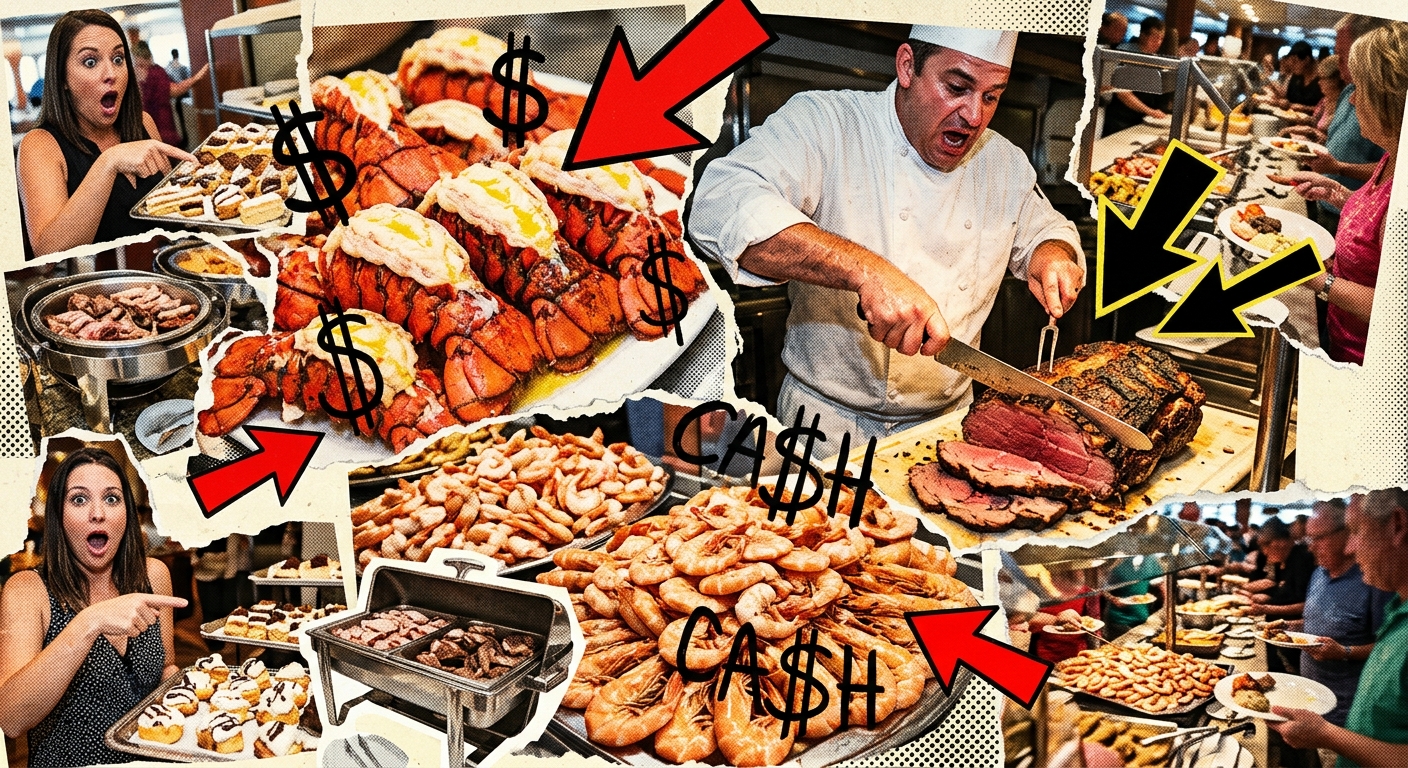

Here’s the thing nobody at the cruise line wants to say out loud — the food situation in 2026 is a strange, two-headed beast. The included food is genuinely good again, finally back from the cost-cutting horror show of 2022 and 2023. The for-pay food is also better. The catch? There’s a lot more for-pay food now. Cruise lines figured out hungry people with all-inclusive expectations will hand over $59 for a steak if you put a candle on the table.
So — what’s actually free, what’s quietly upcharged, and which lines deliver.
The Free Food Reality: It’s Better Than 2019 But Less Than You Think
The “all-inclusive” line in the brochure is doing heavy lifting. Included: the main dining room, the buffet, the pool grill, the pizza counter, the soft-serve, continental room service breakfast, and a rotating cast of casual venues — deli, taco bar, noodle bar.
You will not starve. You will eat very well — if you’re willing to eat their menu, on their schedule.
What’s not included is anything that smells like an experience — steakhouses, sushi bars, hibachi, chef’s tables. Plus most premium ingredients in the MDR (filet, lobster on non-lobster nights), specialty coffees, fresh juices, bottled water, sodas, and every drink with alcohol. And in 2026 most lines have quietly added cover charges to things that used to be free — Norwegian’s Q Texas Smokehouse, Carnival’s Chibang, Royal’s Mason Jar. All used to be casual freebies. All now $25-$45 a head.
The included food has improved. Royal reworked their MDR menus in late 2025 and the entrees finally feel like a real restaurant. Carnival’s buffet got a serious upgrade. But the gap between “included” and “premium” has widened — and premium is everywhere now, designed to make the free stuff feel like the consolation prize.
Main Dining Room vs Buffet: When to Choose Which
Main dining room — sit down, three courses, real plates, a server who remembers your name by night three. Best for dinner, leisurely sea-day breakfast, anytime you want to feel like a person and not a tray. Worst for port days when you’re rushing back from an excursion.
Buffet — variable. Sometimes a revelation, sometimes a war zone. Best for breakfast (eggs to order, fresh fruit, real bacon), port-day lunch, and anytime your group can’t agree on a cuisine. Worst for dinner. Dinner buffet is where the leftover lunch shrimp goes to die.
The move nobody tells first-timers — the MDR is open for lunch on sea days, and it’s almost empty. Same kitchen, served by people who aren’t slammed. The most underrated free meal on the ship.
Before you decide the buffet is beneath you — check the CDC kitchen data. Some are squeaky clean. Others are the reason the inspection report has its own subsection.
Specialty Restaurants: Which Are Worth the Cover Charge
Specialty venues range from genuinely excellent ($65 for a Le Bistro dinner that would cost $140 on land) to genuinely insulting ($59 for a steakhouse where the filet arrives gray). The marketing all uses the same words — “elevated,” “intimate,” “chef-driven.” You have to learn which ones mean it.
Worth it:
- Le Bistro (Norwegian) — French, $59, the only specialty venue consistent across a decade of cost-cutting. Order the duck.
- Murano (Celebrity) — old-school flambé service, the Grand Marnier soufflé, $65, a dinner show with food that holds up.
- Sabatini’s (Princess) — Italian, $35, the cheapest legitimate specialty meal at sea.
- Palo (Disney) — $50, brunch is the move, book it the second your window opens.
Skip: Chops Grille on older Voyager- and Freedom-class Royal Caribbean ships — inconsistent, $59, the same cut you can get free in the MDR on lobster night. Anything called a “fusion concept” — marketing for “we couldn’t decide.”
The actual hack — most lines sell specialty dining packages at 20-40% off the per-restaurant price. If you’ll do two or three specialty nights, the package always wins.
Lobster Night, Indian Buffet, and the Themed Dinner Calendar
Every line has their secret weapon — the free dinner so good it’s basically why regulars keep coming back. You have to know the calendar.
Lobster night — still exists. Not what it used to be. Most lines serve a single Maine tail (5-6 oz, formerly 8 oz) on one designated formal night. Celebrity, Princess, and Holland America still do it well. Royal charges $17 for a second tail. Carnival quietly downgraded to “lobster ravioli” on some itineraries, then loudly upgraded it back when guests revolted. Norwegian’s Cagney’s offers lobster every night — but that’s $59 a head.
Indian buffet — the open secret of British and South Asian cruisers. Most major lines run a full Indian themed buffet at least once per sailing (sea-day lunchtime), and on P&O and Cunard out of Southampton it’s near-religious. Holland America’s is surprisingly excellent.
The chocolate buffet survives on Holland America and Cunard. Carnival’s Mexican night is still a real event. The Captain’s Gala buffet has been quietly retired across most fleets.
The play — when you board, find the daily program, scan for “Indian,” “lobster,” “gala,” “themed.” Plan your week. The line is not going to remind you. Free food this good doesn’t get advertised because they’d rather you discover the $59 steakhouse instead.
Room Service: What’s Included vs the Hidden Fees
This is where the most people get burned. Room service used to be the simple, unambiguous free thing. Now? A three-tier system designed to look free until it isn’t.
Free: the continental breakfast menu (pastries, fruit, cereal, coffee, juice), via the door tag the night before. Still exists. Still free.
Free with a service charge: the all-day menu (sandwiches, salads, pizza on some lines) is “included” but carries a $4.95-$9.95 service fee per order. Royal started it in 2019. Carnival charges $5. Norwegian $9.95. Princess waives it for suite guests.
Paid menu: the steaks, the seafood, the bottle of wine you didn’t think you ordered.
The grift is that the all-day menu used to be free with no fee, then quietly became “free but $9.95,” and that fee gets pre-loaded into your folio and people don’t notice. You can still get a free in-room continental breakfast. You just have to use the door tag, not the phone.
Most ships also charge 18-20% gratuity on any paid room service item, on top of the service fee — a $20 cheeseburger becomes $33.95. For what gratuities you can and can’t get out of, see our main cruise tipping guide.
Drinks Aren’t Food: But They’re 80% of the Bill Anyway
Free: tap water, buffet-dispenser lemonade or fruit juice, regular coffee (the bad kind), regular tea, iced tea on most lines. That’s the list.
Not free: bottled water (yes, even still, $4-7), all sodas, all specialty coffees (espresso, latte, cappuccino), fresh-squeezed OJ, smoothies, milkshakes, energy drinks, all alcohol.
Drink packages are the trap. $79/day on Royal, $109 on Celebrity, $89 on Norwegian. To break even you need seven or eight alcoholic drinks a day, every day. Some will. Most, after day three, won’t. Run the math.
The good play — refillable soda cups ($8-12/day) and the specialty coffee package on lines that offer it ($25-35/day, worth it if you drink three or more a day).
Cruise Line Food Rankings: The Honest 2026 Tier List
Based on the included food, not the specialty venues. No PR spin.
| Tier | Cruise Lines | What They Do Best | Honest Caveat |
|---|---|---|---|
| S-Tier | Disney, Celebrity, Princess | Disney’s rotational dining is theme-park excellent. Celebrity’s MDR cuts above. Princess’s International Cafe is the best 24-hour free spot at sea. | You’re paying for it in the fare. |
| A-Tier | Royal Caribbean, Norwegian, Holland America | Royal’s Windjammer has a real cuisine rotation. Norwegian’s specialty package math is unbeatable. Holland America’s Indonesian rijsttafel night is legendary. | Quality varies wildly by ship class. Newer beats older. |
| B-Tier | Carnival, MSC | Carnival’s Guy’s Burger Joint and BlueIguana Cantina are genuinely good free fast food. MSC’s Italian buffet is the best buffet pasta at sea. | MDR dinner is the weak point. Stick to the casual venues. |
| Luxury (Separate Tier) | Cunard, Oceania, Silversea, Regent, Viking | Specialty restaurants included. Wine included. Caviar included. Oceania’s Polo Grill steak beats any mainstream specialty steakhouse. | $400-700/day per person versus $80-150 on mainstream lines. |
Disney sits at S-tier because the rotational dining works and the kids’ menus are real food, not chicken-fingers-forever. For the full breakdown, see our full Disney Cruise Line dossier. And whatever line you pick — you can always look up any ship’s CDC food safety record before you sail.
FAQ: Cruise Ship Food
Is cruise ship food really included?
Mostly yes — the main dining room, buffet, pool grill, pizza, soft-serve, and continental room service breakfast are included on every major mainstream line. Not included: specialty restaurants ($20-75 per person), most room service beyond continental breakfast (service fee + sometimes paid menu), bottled water, sodas, specialty coffees, fresh juices, and all alcohol. Luxury lines (Cunard, Oceania, Silversea, Regent, Viking) include specialty restaurants and most drinks — but the fare is much higher.
Are specialty restaurants worth it on a cruise?
Sometimes. Worth the cover: Le Bistro on Norwegian, Murano on Celebrity, Sabatini’s on Princess, Palo on Disney. Often not: steakhouses on older ships (Chops Grille on Voyager-class Royal Caribbean). The actual hack — buy a specialty dining package if you’ll go more than once. Most lines run sales at 20-40% off per-restaurant prices, which always beats paying per visit.
Do you have to pay for room service on a cruise?
Depends what you order. The continental breakfast (pastries, fruit, coffee, juice) via the door hanger the night before is genuinely free on most major lines. The all-day room service menu (sandwiches, salads, pizza on some lines) carries a service fee of $4.95-$9.95 per order on Royal Caribbean, Carnival, Norwegian, and Princess — even though the food itself is “included.” Premium room service items (steaks, full meals from specialty menus) are an additional charge. Suite guests often get the service fee waived.
Which cruise line has the best food?
For included food on a mainstream line, the honest ranking is Disney, Celebrity, and Princess in the top tier — Disney for rotational dining and kids’ menus, Celebrity for a main dining room that punches above the rest, Princess for its International Cafe and dessert program. Royal Caribbean, Norwegian, and Holland America sit just below. Carnival and MSC are strongest in casual venues and weakest in the MDR. If money is no object, the luxury lines — Oceania, Cunard, Silversea, Regent, Viking — are in their own tier with included specialty restaurants and wine.
Is the lobster on a cruise free?
On the designated lobster night — yes, included, typically one Maine lobster tail per guest (5-6 oz). Lobster night is usually on a formal night on most mainstream lines including Royal Caribbean, Celebrity, Princess, and Holland America. Carnival has wavered — they downgraded to lobster ravioli on some itineraries, then reinstated lobster tail after guest pushback. Want a second tail? Royal charges $17. Want lobster every night? That’s Cagney’s on Norwegian, $59 a head.
How much should I budget for food extras on a cruise?
Plan for $30-80 per person per day if you intend to do specialty restaurants, premium room service, or specialty coffees. Two specialty dinners alone are typically $100-130 per person before gratuity. A specialty dining package across a 7-night cruise runs $150-220 per person. Add a coffee package ($25-35/day) and a few bottled waters and you’re at $50/day before drinks. Drinks are a separate budget line — assume $80-110/day on an alcohol package, or $15-30/day sticking with included drinks plus an occasional cocktail.
The Bottom Line
The “all-inclusive cruise food” pitch is mostly true — you can board, never spend a cent beyond your fare, and eat better than you would at home for a week. The included food in 2026 is the best it’s been since 2019.
What’s changed is how aggressively the lines surround the free food with paid food, paid drinks, paid services, and paid upgrades. Every venue has a premium version one deck up. Every meal has a “premium ingredient” upgrade for $19. Every drink has a package that sounds like a deal until you do the math.
The cruise that costs $800 in fare and ends up with a $1,400 onboard bill is not an accident — it’s the business model. Knowing where the free food actually is, when it’s actually good, and which upcharges are worth it is what separates the cruisers who got their money’s worth from the ones writing angry Reddit threads about feeling nickeled-and-dimed.
Eat the lobster. Skip the gray steakhouse. Use the door tag for breakfast. And for the love of all things holy — check the buffet’s inspection score before you load up that plate.

Try our free cruise games & calculators
Explore real CDC inspection scores and outbreak data for every cruise ship.