
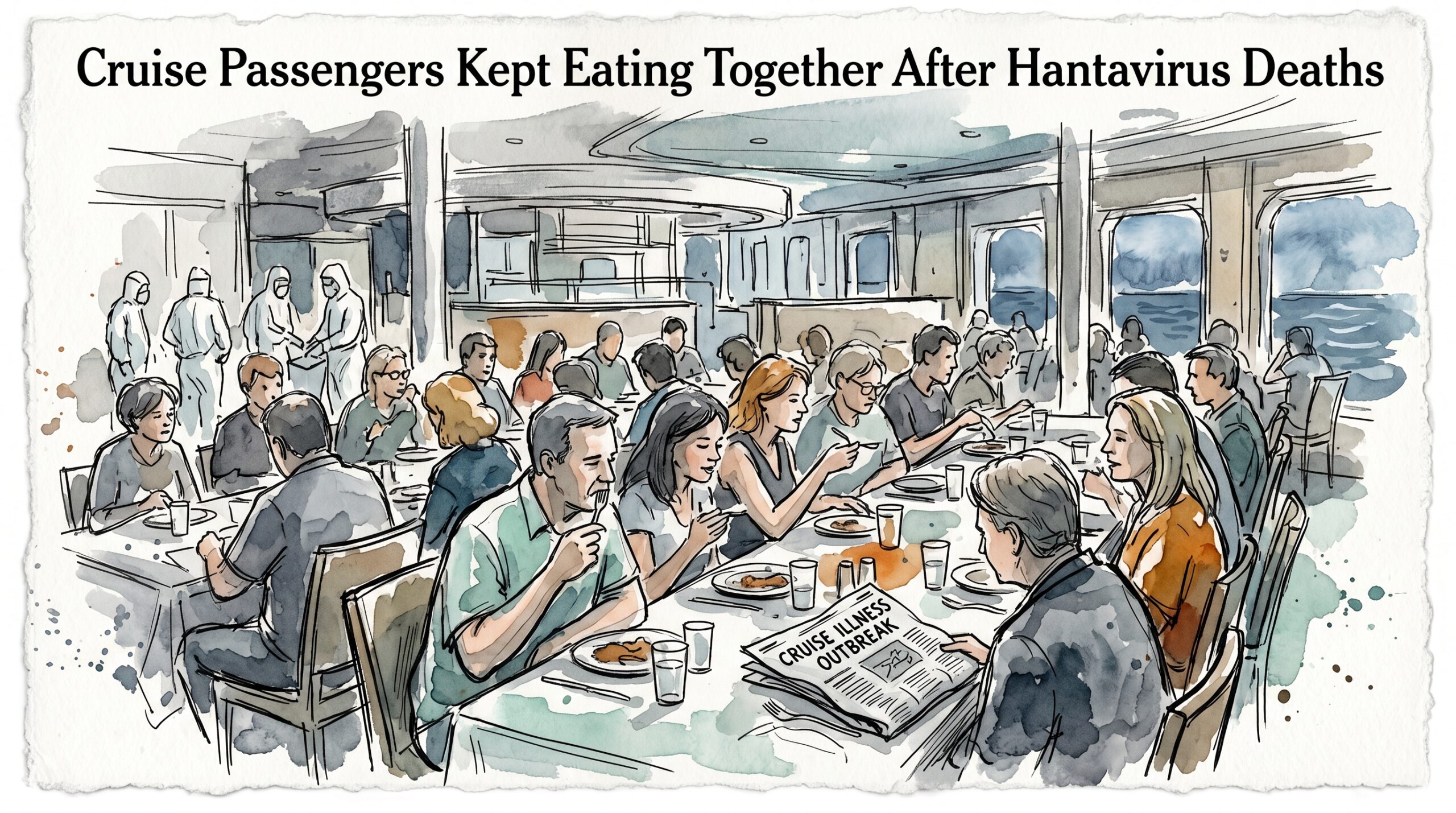

After the first passenger died, the captain told everyone it was natural causes. Then — and this is the part that should keep you up at night — they all sat down to eat dinner together anyway. Side by side. Passing the bread rolls. Making small talk. On a ship that, as it turns out, was in the middle of a hantavirus outbreak carrying a 40% fatality rate.
Tea TempLast updated: May 20, 2026
Read that again.
“The Ship Is Not Infectious” — Famous Last Words
According to a passenger account reported by CTV News, after the first death aboard the vessel, passengers were explicitly told the ship was “not infectious.” The captain reportedly attributed the death to natural causes. So passengers did what you do when you’re on a cruise and you’ve been reassured that everything is fine: they kept eating their communal meals, side by side, with 82 other people who were now — unbeknownst to any of them — potentially exposed to one of the rarer, nastier strains of hantavirus on the planet.
This is the part of the story where you have to ask yourself some very uncomfortable questions about what cruise lines owe their passengers in terms of, oh, basic information about fatal pathogens aboard a sealed vessel in the middle of the ocean.
The Andes Strain Is Not Your Average Wilderness Warning
Here’s what makes this particular outbreak especially grim: the WHO has confirmed this is the Andes strain of hantavirus. The Andes strain is notable for two reasons. First, it has roughly a 40% fatality rate — meaning if you contract it, you have about the same odds as a coin flip. Second — and this is the part that escalated an already-serious situation into a global health incident — it is the only known strain of hantavirus that can spread from person to person.
Most hantavirus transmission happens through contact with infected rodent droppings. The Andes strain can pass human-to-human. On a cruise ship. Where 82 people were eating together. Side by side.
Let that sink in.
Three Deaths, Twelve Countries, One Ship Still at Sea
The WHO has confirmed three deaths linked to this outbreak. Health authorities across 12 countries are now trying to track down the 82 passengers who were exposed — because people got off that ship and went home to a dozen different nations before the full picture became clear. Spain is reportedly readying for evacuations as the vessel makes its way toward the Canary Islands.
Ten Canadians have been identified as connected to the outbreak. As of the latest reporting, all ten are asymptomatic — which is a relief, though the incubation period for hantavirus means that picture can change. Health officials are actively monitoring them.
This is now a live WHO-tracked international outbreak. It started on a cruise ship. It may have been allowed to spread because passengers were kept in the dark while sitting down to communal dinners.
The Information Problem Is Its Own Catastrophe
We don’t yet know the full chain of events — who knew what, when, and what decisions were made by ship’s medical staff versus senior crew. These things take time to investigate. But what a passenger has described — being told the ship was “not infectious” after a death from what we now know was a human-transmissible virus with a 40% kill rate — is, if accurate, a staggering failure of passenger communication.
This isn’t a story about whether the cruise line could have prevented the initial infections. Hantavirus is rare, the Andes strain is rarer, and nobody boards a ship expecting to be at risk from it. This is a story about what happened after — after someone died, after medical staff presumably had some awareness of a serious illness, and passengers continued eating their meals together, unwarned, in an enclosed floating environment.
If you’re tracking how cruise ships handle onboard illness outbreaks, our cruise ship outbreak tracker covers the full history — and this one is going to be a case study for a long time.
What We Know
- Virus: Andes strain of hantavirus — the only known human-to-human transmissible strain, ~40% fatality rate
- Deaths: 3, confirmed by the WHO
- Exposed passengers: 82 being traced across 12 countries
- What passengers were told: First death attributed to “natural causes” by the captain; ship described as “not infectious”
- Passenger behavior: Communal meals continued side by side after the first death, per passenger account
- Canadians affected: 10 connected to the outbreak, all asymptomatic as of latest reports
- Current status: Ship heading toward the Canary Islands; Spain preparing for potential evacuations; WHO has issued a warning to 12 countries
Try our free cruise games & calculators
Explore real CDC inspection scores and outbreak data for every cruise ship.