
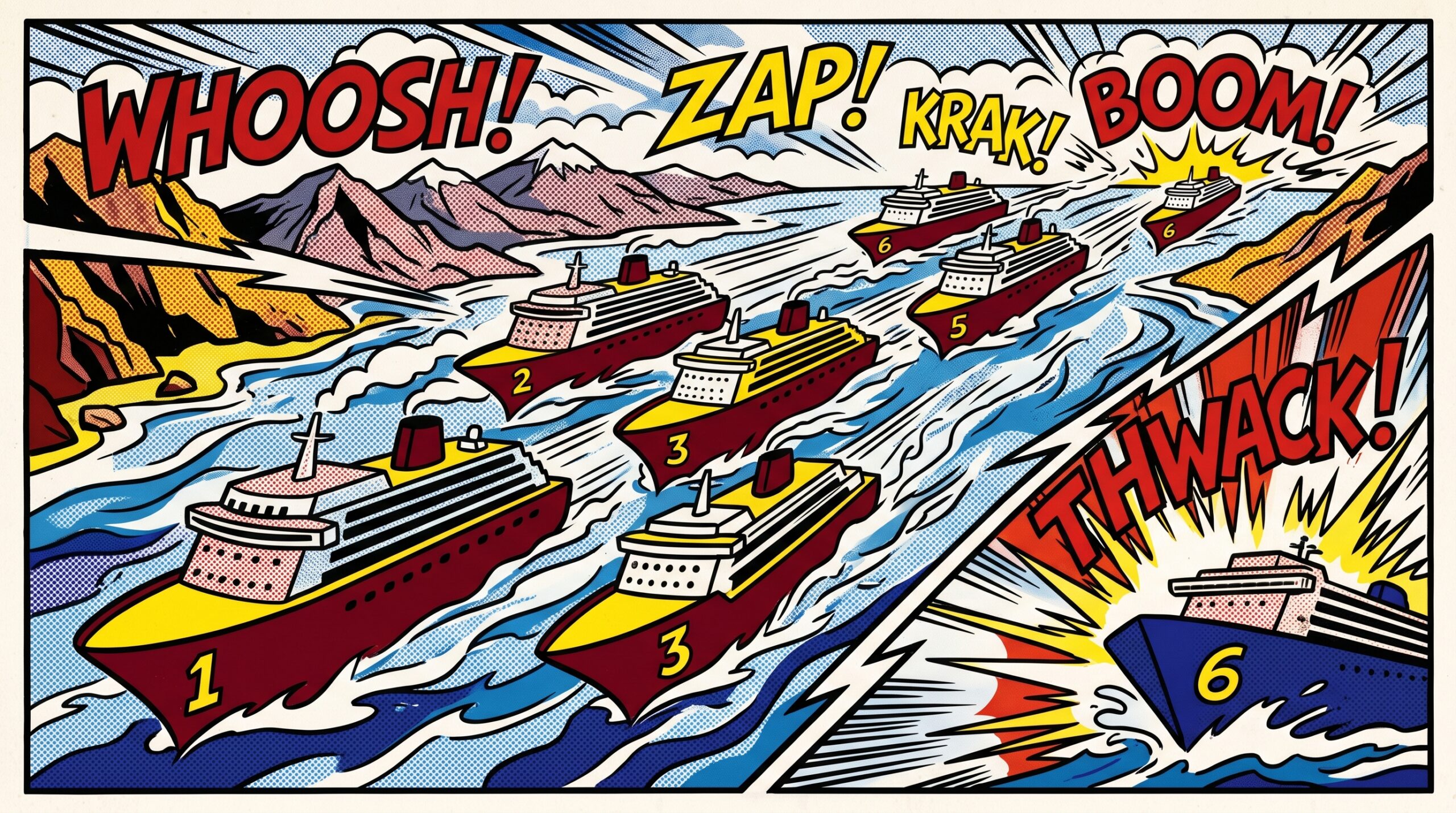

Six cruise ships. One of the most militarily volatile waterways on the planet. A passage that people are calling — and I want you to sit with this word — an escape.
Tea TempLast updated: May 20, 2026
That’s not cruise industry language. “Escape” is not how port authority press releases get written. “Escape” is how you describe something when the alternative was genuinely on the table.
Let’s Talk About Where This Happened
The Strait of Hormuz is about 21 miles wide at its narrowest point. It sits between Iran and the Omani peninsula, and roughly 20% of the world’s oil supply moves through it. Militaries from multiple nations have active presence there. It has been the site of ship seizures, drone attacks, and standoffs. It is, to use a technical maritime term, extremely not chill.
This is where six cruise ships — carrying what we can safely assume were thousands of passengers who signed up for cocktails and shore excursions, not geopolitical incident management — reportedly made a coordinated transit passage.
Together. In formation. Getting out.
The Word “Coordinated” Is Doing A Lot of Heavy Lifting Here
Cruise ships do not typically convoy through straits like they’re in a WWII documentary. When six ships are moving together in what’s being described as a coordinated passage, that tells you something: someone looked at the situation and decided that six ships together was meaningfully safer than six ships going through one at a time.
That is a decision that involves calls with maritime security consultants. With flag states. With naval escorts or at minimum naval awareness. That is not the kind of decision a port captain makes over breakfast. Someone, somewhere, assessed the threat conditions and determined this was the move.
Read that again. The threat conditions. For a cruise.
The Gulf Has Been a Lot Right Now
This incident doesn’t exist in a vacuum — the Persian Gulf and surrounding waters have been a genuinely tense operating environment for maritime traffic. The Strait of Hormuz in particular has been a flashpoint, and cruise lines operating itineraries through that region have been navigating an increasingly complicated security picture.
To their credit — and I say this with only mild reluctance — cruise lines have gotten better at contingency routing when things get dicey. Reroutes, cancellations, port substitutions. The math of keeping a ship and its thousands of passengers out of harm’s way has become an unfortunately regular calculation in this part of the world.
But six ships making a coordinated passage that’s being framed as an escape? That’s a new wrinkle.
What This Means If You’re Booked on a Gulf Itinerary
Here’s the thing about cruise contracts — and cruise lines are very aware of this — the lines reserve the right to alter itineraries for safety reasons. That’s always been true. What’s changed is how often that clause is getting exercised in this region.
If you’re booked on anything routing through the Persian Gulf, the Strait of Hormuz, or ports in the UAE or Oman right now, you need to be paying attention to your cruise line’s communications. Not paranoid — paying attention. There’s a difference. These situations develop fast and the lines are generally trying to route around danger, not into it.
That said, “trying to route around it” and “coordinated escape passage through one of the world’s most dangerous straits” are not descriptions that belong in the same marketing brochure. Just saying.
What We Know
- What happened: Six cruise ships reportedly made a coordinated passage through the Strait of Hormuz under active threat conditions
- Location: Strait of Hormuz — the narrow waterway between Iran and Oman connecting the Persian Gulf to the Gulf of Oman
- Framing: The passage is being described as an “escape,” suggesting conditions were not routine transit
- Nature of passage: Coordinated — multiple ships moving together rather than independently, implying deliberate security planning
- Injuries/casualties: None reported
- Outcome: Ships cleared the strait; broader regional tensions remain
- Context: Part of an ongoing pattern of elevated maritime security conditions in the Gulf region
Six ships. One very tense strait. The kind of headline that makes you look up what “force majeure” means in your booking terms. We’ll keep watching this one — the Gulf isn’t getting less complicated anytime soon.
Try our free cruise games & calculators
Explore real CDC inspection scores and outbreak data for every cruise ship.