
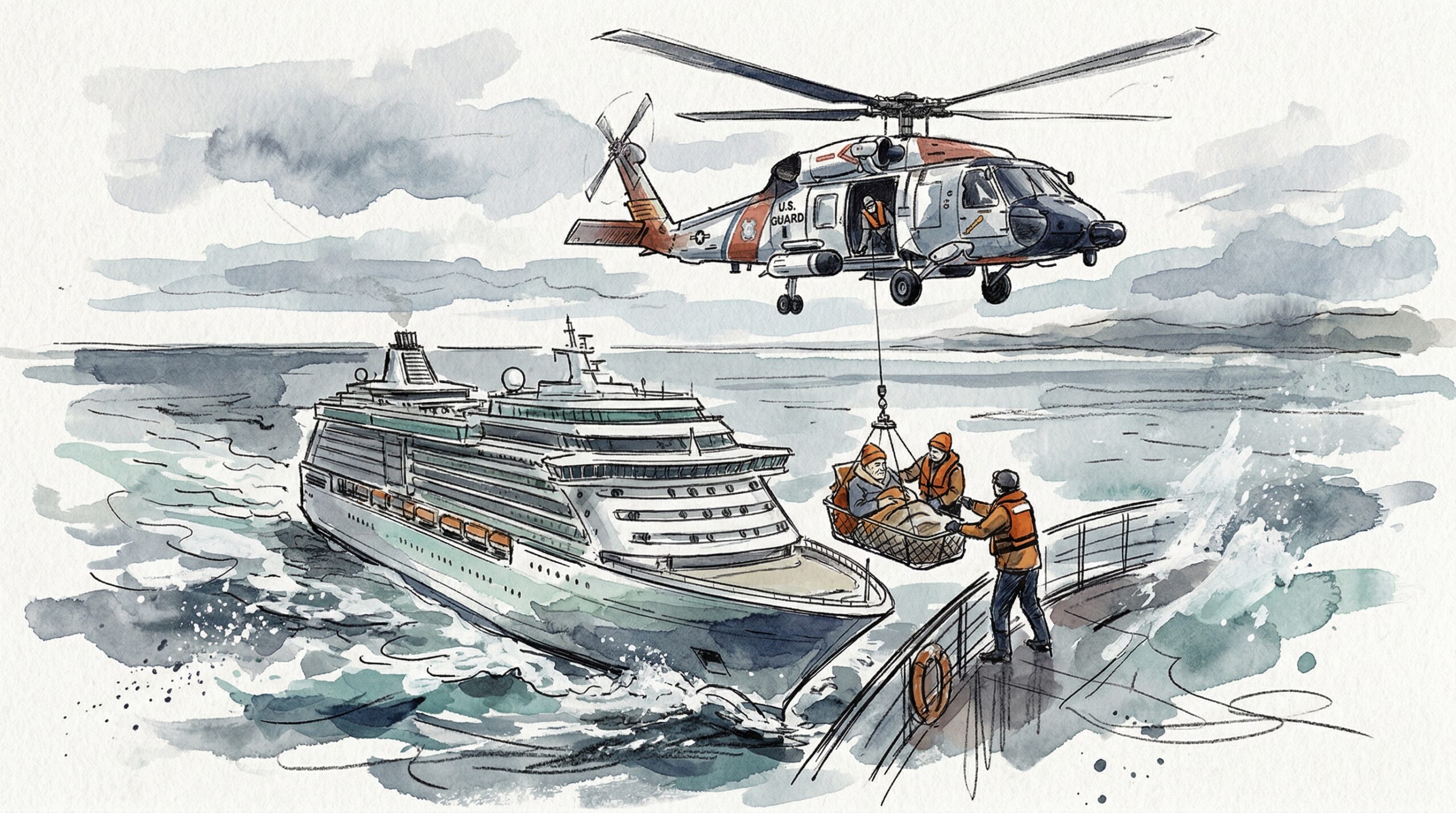

On March 9, 2026, two passengers aboard the Ruby Princess needed to be airlifted off the ship at the same time. One was a 52-year-old woman in cardiac arrest. The other was a 99-year-old man with an esophageal obstruction so severe he couldn’t breathe or swallow.
Tea TempLast updated: March 23, 2026
The ship was 145 nautical miles west of Cape Flattery, Washington. That’s open Pacific Ocean. No nearby port. No quick fix. Two helicopters were scrambled from two different countries.
Two Emergencies, Two Countries, One Ship
When Ruby Princess put out the emergency call, the US Coast Guard and the Royal Canadian Air Force both responded. This wasn’t a routine medevac — two life-threatening cases happening simultaneously on a ship far from shore required a coordinated international response.
The 99-year-old man was hoisted from the deck by helicopter and flown to Victoria, British Columbia. Let that image sit for a moment: a 99-year-old being winched from a cruise ship deck in a rescue basket, dangling over the Pacific, before being flown across the border to a Canadian hospital.
The 52-year-old woman was transferred to a separate aircraft and taken to a hospital in Washington State.
Why This Was So Complicated
Most cruise ship medical evacuations involve one patient, one helicopter, and a ship that’s reasonably close to land. This one broke every norm:
- Two simultaneous life-threatening emergencies — both requiring immediate evacuation
- 145 nautical miles from shore — at the extreme range of helicopter operations
- Open Pacific conditions — wind, waves, and a moving ship deck
- International coordination — US Coast Guard and Royal Canadian Air Force working together in real time
- A 99-year-old patient — hoisting someone that age from a ship is extraordinarily high-risk
Helicopter rescues at sea are already dangerous. The helicopter has to match the ship’s speed, lower a rescue swimmer, stabilize the patient, secure them in a basket, and hoist them up while both the ship and helicopter are moving in ocean swells. Doing that for a 99-year-old in respiratory distress multiplies the risk exponentially.
The Age Question Nobody Wants to Ask
Cruise ships have medical facilities, but they’re not hospitals. They have doctors and nurses, but they’re limited in what they can handle. An esophageal obstruction in a 99-year-old isn’t something you treat with the onboard equivalent of a clinic.
There’s an unspoken conversation in the cruise industry about age limits and medical screening. Cruise lines don’t set maximum age requirements — if you can board, you can sail. But when something goes wrong 145 miles from shore, the resources required to save one passenger can be extraordinary.
Both patients were reported alive when they reached their hospitals. That’s a testament to the Coast Guard, the Canadian Air Force, and the Ruby Princess medical team.
Want to know how Princess ships perform on health and safety? Check our rankings or look up Ruby Princess.
The Facts
- Ship: Ruby Princess (Princess Cruises)
- Date: March 9, 2026
- Location: 145 nautical miles west of Cape Flattery, Washington (open Pacific)
- Patient 1: 52-year-old woman, cardiac arrest — flown to Washington State hospital
- Patient 2: 99-year-old man, esophageal obstruction — flown to Victoria, BC, Canada
- Rescue units: US Coast Guard helicopter + Royal Canadian Air Force aircraft
- Injuries: Both patients alive on hospital arrival
- Notable: Dual simultaneous medevac requiring international military coordination
Try our free cruise games & calculators
Explore real CDC inspection scores and outbreak data for every cruise ship.