
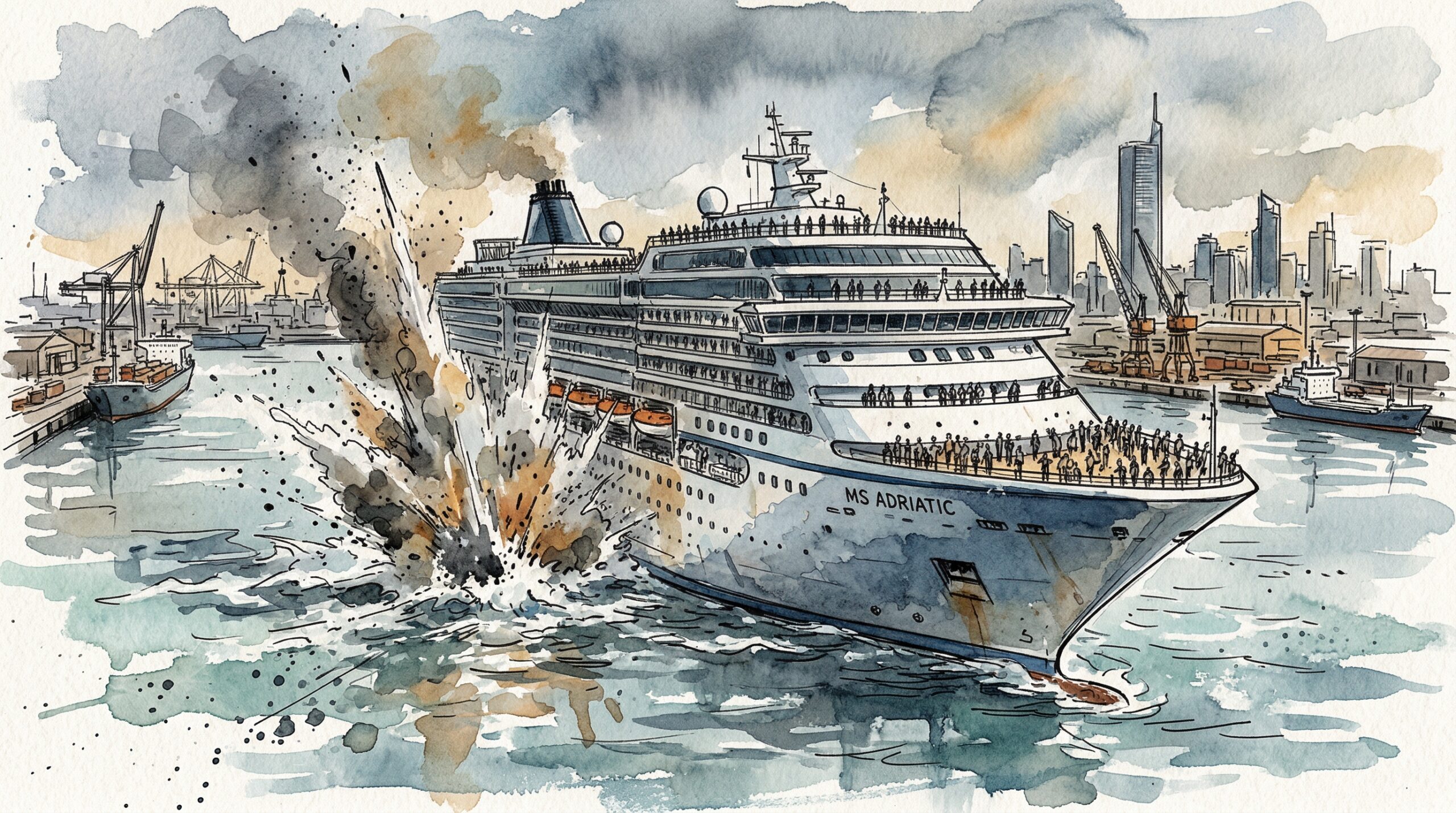

On March 1, 2026, an Iranian missile landed in the water just meters from the Mein Schiff 4 — a cruise ship carrying 2,500 German tourists — while it was docked at Zayed Port in Abu Dhabi.
Tea TempLast updated: March 27, 2026
How safe is YOUR cruise ship? Look up any ship’s inspection scores, safety incidents, and overall grade on our Ship Report Cards. Or play Spill or Chill — can you tell real cruise headlines from fake ones?
Read that again. A missile. Meters from a cruise ship. Full of vacationers.
What Happened
Following the US and Israeli strikes on Iran on February 28, Iran launched retaliatory missile and drone attacks against targets across the Middle East. One of those missiles landed in the water at Zayed Port in Abu Dhabi — right next to where Mein Schiff 4, operated by TUI Cruises, was berthed with a full load of passengers.
Passengers reported a loud explosion and a visible smoke plume rising from the water just off the ship. Crew immediately ordered all 2,500 guests indoors, away from windows and open decks. German media described panic spreading through the ship as passengers tried to figure out whether they were under attack.
They were not the target. But when a missile lands close enough to rattle the windows, that distinction doesn’t feel very comforting.
Then It Got Worse: Six Ships Trapped in a War Zone
The missile was just the beginning. In the hours and days that followed, the entire region’s airspace shut down. The UAE grounded flights. Iran threatened to attack any vessel attempting to transit the Strait of Hormuz. And suddenly, six cruise ships carrying thousands of passengers were stuck — unable to sail out through the strait, and unable to fly their passengers home.
The ships stranded included:
- Mein Schiff 4 — Abu Dhabi (the missile ship)
- Mein Schiff 5 — Doha, Qatar
- MSC Euribia — Dubai
- Celestyal Journey — Doha
- Celestyal Discovery — Abu Dhabi
- Resorts World One — In the region
Hotels in Dubai and Abu Dhabi hit 100% occupancy within 48 hours. Around 30,000 German tourists alone were stranded across the Gulf states. Passengers described going from “vacationers to those awaiting evacuation” overnight.
TUI Cruises immediately suspended operations for both Mein Schiff vessels and canceled multiple upcoming sailings (March 1, 3, 8, and 9). They worked with the German Federal Foreign Office to arrange repatriation flights.
Let That Sink In
Cruise passengers have dealt with norovirus outbreaks, power failures, and the occasional rogue wave. But a ballistic missile landing next to your ship while geopolitical superpowers exchange fire around you? That’s a new one.
The cruise industry has been expanding into the Middle East aggressively over the past few years — Dubai, Abu Dhabi, Qatar, Oman, and Saudi Arabia have all been pitched as the next big cruise destinations. And for the most part, they’ve been perfectly safe. But this is a stark reminder that “safe right now” and “safe forever” are very different things.
Nobody was hurt on Mein Schiff 4. But the margin was measured in meters, not miles.
Want to see how ships are rated on safety? Check our cruise ship rankings or look up any ship’s report card.
What We Know
- Ship: Mein Schiff 4 (TUI Cruises)
- Date: March 1, 2026
- Location: Zayed Port, Abu Dhabi, UAE
- Passengers aboard: ~2,500 (predominantly German tourists)
- What happened: Iranian missile landed in the water meters from the docked ship
- Injuries: None reported aboard the ship
- Aftermath: 6 cruise ships stranded in the Gulf region; TUI suspended operations; multiple sailings canceled
- Stranded tourists: ~30,000 German nationals across UAE and Qatar
- Resolution: Repatriation flights arranged via German Federal Foreign Office
This is the kind of story that changes how people think about cruise itineraries. We’ll be watching how the major lines adjust their Middle East routes in the months ahead.
Try our free cruise games & calculators
Explore real CDC inspection scores and outbreak data for every cruise ship.