
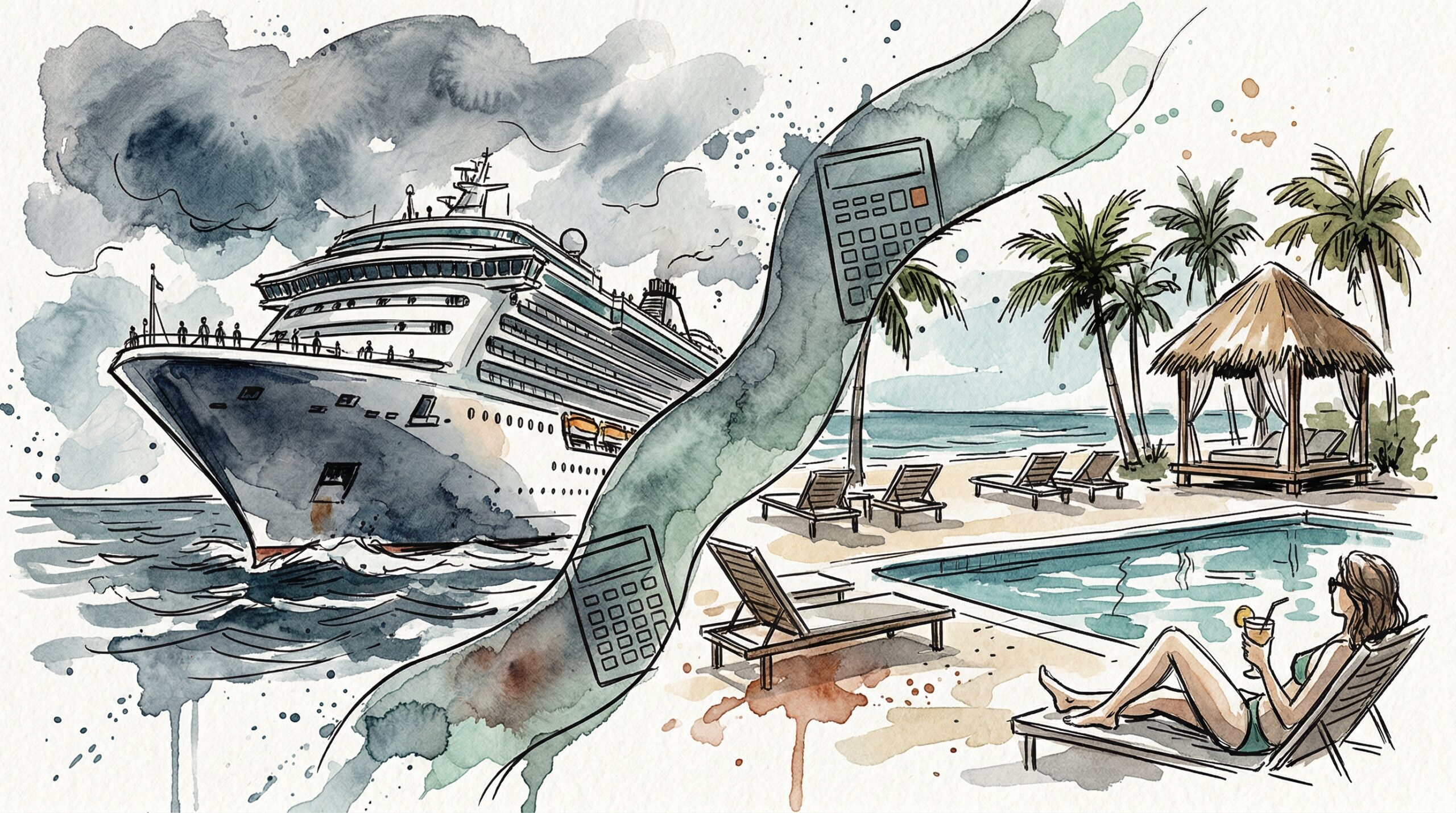

Every year, the same argument erupts in group chats, family dinners, and couples’ therapy sessions worldwide: cruise or resort? Both sides have strong opinions and suspiciously selective math. The cruise people will tell you it’s the best value in travel. The resort people will tell you that you can’t put a price on not being trapped on a boat. Everyone conveniently forgets to include the costs that make their side look worse.
Last updated: March 23, 2026
We’re here to end this with actual numbers. You’re welcome.
The Problem With This Comparison
The reason this debate never gets resolved is that people compare the wrong things. They’ll compare the cruise fare (which includes meals) against just the resort room rate (which doesn’t), then declare cruising the winner. Or they’ll compare an all-inclusive resort (where drinks are “free”) against a cruise where they’re paying per cocktail, then declare the resort the winner.
It’s apples to oranges wrapped in confirmation bias.
A fair comparison needs to account for EVERY category of spending on both sides, using the same assumptions. That’s exactly what our Cruise vs Resort Calculator does. And the results might surprise both camps.
The Categories That Actually Matter
Accommodation
A cruise cabin and a resort room are not the same thing, and everyone knows it. Even the nicest cruise cabin is smaller than a standard hotel room. A balcony cabin on a mainstream cruise line is roughly 180 square feet; a decent resort room is 300-400. If you’re in an interior cruise cabin, you’re basically sleeping in a walk-in closet with a bed. Comfortable? Surprisingly, yes. Comparable to a resort room? Be serious.
But the cruise cabin comes with daily housekeeping, room service, and a view that changes every day (if you sprung for the balcony). The resort room comes with space. Different value propositions.
Food and Dining
This is where cruises have a legitimate edge. Your cruise fare includes the main dining room and buffet, which means three meals a day are “free” (pre-paid). At a resort, even an all-inclusive one, there are often restrictions, limitations, or quality differences between included and premium dining.
But — and this is a big but — most cruisers also spend on specialty restaurants, which are $25-75 per person per meal. When you add that to the analysis, the food advantage shrinks considerably. Our food safety data shows cruise ship kitchens are well-inspected, at least.
Drinks
This is where the comparison gets spicy. All-inclusive resorts include unlimited drinks. Cruises (mostly) don’t. If you’re a drinker, this is potentially a massive cost difference — unless you buy the cruise drink package, which runs $60-100 per day per person. Check our Drink Package Calculator to see if that makes sense for you.
Our calculator has a “Plot Twist” feature that recalculates both scenarios with honest drinking estimates. Because the version where you “only have a couple of drinks” and the version where you actually drink like you’re on vacation are very different budgets.
Activities and Entertainment
Cruise ships are floating entertainment complexes. Shows, pools, rock climbing walls, water slides, game shows, trivia — all included. Resort activities vary wildly, from “here’s the pool” to full programs with water sports, spa access, and excursions.
Port excursions on a cruise are the wildcard. They’re not cheap ($50-300+ per person per port), and they’re a major part of the cruise experience. A resort doesn’t have this cost category at all, because you’re already AT the destination.
Transportation
This is the hidden cruise advantage or disadvantage, depending on your situation. A cruise includes transportation between destinations. Flying to a resort is on you. But you also have to get to the cruise port, which might require a flight too. The calculator accounts for both scenarios.
The Stuff Nobody Mentions
Cruise: gratuities ($14-22/day/person), WiFi ($15-40/day), port taxes, travel insurance. Resort: airport transfers, rental car, dining out (if not all-inclusive), tips, activities. Both sides have hidden costs, and both sides conveniently forget to mention them. Our True Cost Calculator covers the cruise side in detail. The resort calculator does the same for the land-based option.
The Plot Twist Section
Our favorite feature of the calculator: after showing you the initial comparison, it asks if you want to see the “Plot Twist” — a recalculation that adjusts your drinking estimates to vacation-realistic levels. Because the sober version of you planning the trip and the poolside version of you living the trip have very different relationships with the bar menu.
For some people, this recalculation flips the winner entirely. A cruise that was cheaper on paper becomes more expensive when you factor in real drinking. An all-inclusive resort that seemed pricey suddenly looks like genius-level budgeting when unlimited drinks are genuinely unlimited.
What You’re Giving Up
The calculator also generates a “What You’re Giving Up” list for whichever option loses. Because cost isn’t everything. Choosing a cruise means giving up space, beach access, and destination immersion. Choosing a resort means giving up variety, the experience of multiple ports, and the sheer novelty of waking up in a different place every morning.
Money can be compared. Experiences are harder to quantify. But at least the money part should be settled with data, not vibes.
Run the Comparison
Enter your actual numbers — real cruise quotes, real resort rates, honest drinking estimates — and let the calculator settle the debate once and for all.
Try the Cruise vs Resort Calculator — bring data to the group chat argument.
More cruise planning tools:
- True Cost Calculator — Full breakdown of cruise costs
- Drink Package Calculator — Should you buy the package?
- Tipping Calculator — Gratuity estimates by cruise line
- Tipping by Cruise Line 2026 — What each line charges
- Seasickness Risk Calculator — Because this matters for the decision too



Try our free cruise games & calculators
Explore real CDC inspection scores and outbreak data for every cruise ship.