
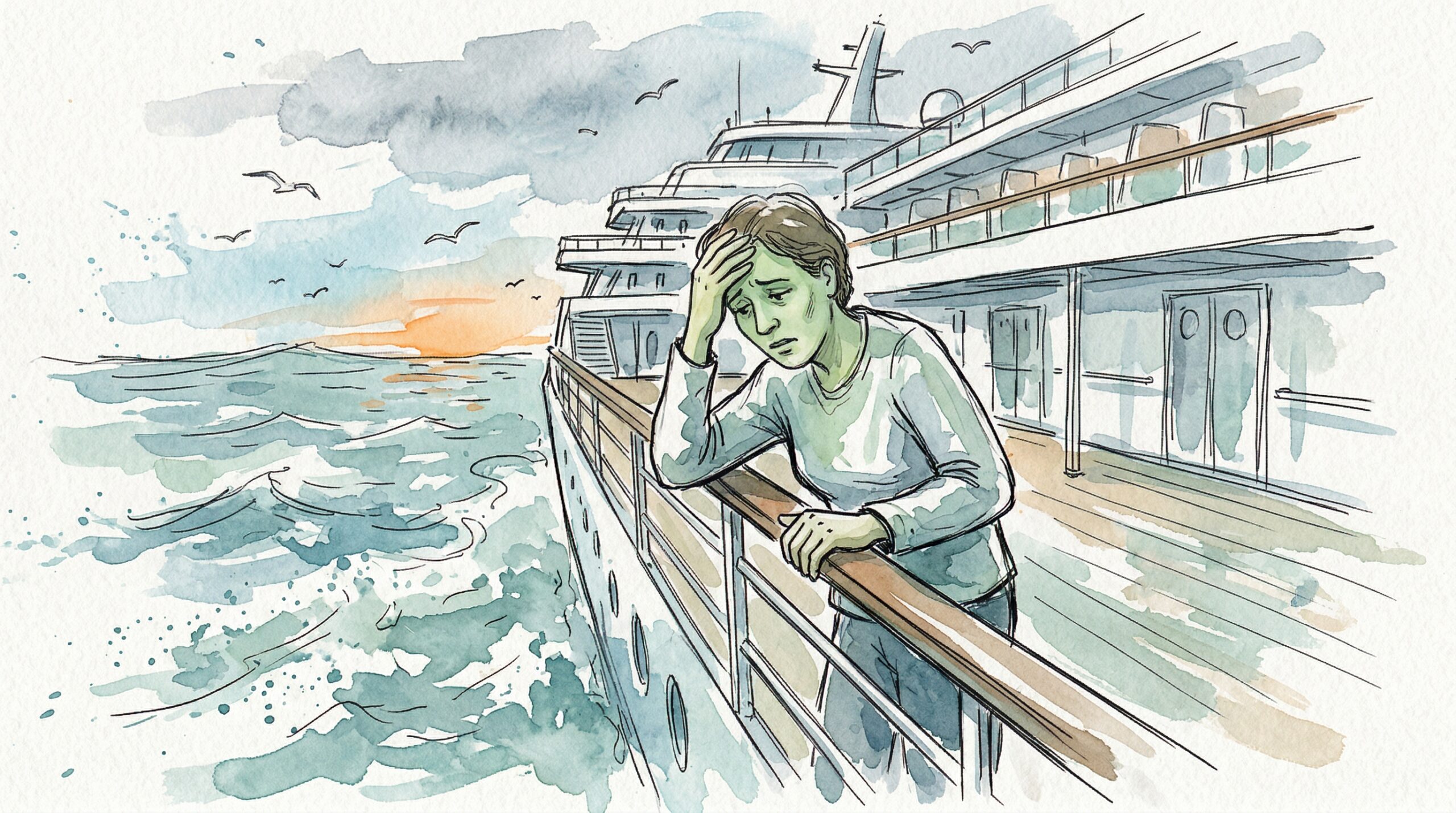

There are two types of people in the world: those who’ve never been seasick, and those who’ve experienced the existential crisis of staring at a toilet in a tiny cabin while the ocean gently reminds them who’s in charge. If you’re booking a cruise and wondering which category you’ll fall into, we have thoughts. And a calculator.
Last updated: March 23, 2026
Seasickness is the great unspoken fear of cruising. Nobody puts it in their Instagram caption. The cruise lines certainly don’t feature it in commercials. But every single cruise ship stocks Dramamine at the gift shop for a reason, and that reason is you (possibly).
The Truth About Seasickness on Modern Cruise Ships
Here’s some genuinely good news: modern cruise ships are significantly more stable than anything your grandparents sailed on. Today’s megaships are equipped with stabilizer fins, computer-controlled ballast systems, and sheer mass on their side. A 230,000-ton ship doesn’t rock the same way a fishing boat does. Physics is on your team.
That said, physics has limits. Rough seas are rough seas, and even the biggest ships feel them. The difference between a smooth and rough cruise can be dramatic, and it depends on factors most people never think about until they’re gripping the handrail at 3 AM.
What Actually Determines Your Risk
Your Personal History
If you get carsick, airsick, or queasy on roller coasters, your odds of seasickness are meaningfully higher. The vestibular system (your inner ear’s motion detection) doesn’t care whether the motion comes from a car, a plane, or a floating city. Some people have sensitive vestibular systems. It’s not a weakness; it’s a feature that would have been very useful on prehistoric hunting grounds and is profoundly useless on a Carnival ship.
Your Age and Demographics
Women are more susceptible than men (sorry). Children between 2-12 are the most susceptible of all (extra sorry to the parents). Interestingly, susceptibility tends to decrease after 50. So at least aging has ONE perk.
Your Ship and Itinerary
Ship size matters enormously. A 6,000-passenger megaship handles waves completely differently than a 500-passenger boutique vessel. Itinerary matters too — a Caribbean cruise in calm waters is a different experience than crossing the North Atlantic in November. You can browse our ship database to compare ship sizes before booking.
Your Cabin Location
This is the thing most first-timers get wrong. Where your cabin sits on the ship makes a HUGE difference in how much motion you feel. The physics are simple: the center of the ship at the waterline moves the least. The top deck at the front of the ship moves the most. Choosing the right cabin can be the difference between sleeping peacefully and redecorating the bathroom.
Time of Year
Hurricane season (June-November for the Caribbean and Atlantic) means rougher seas. Winter crossings of any ocean are rockier than summer ones. Even the Mediterranean gets choppy from November through March. The calendar matters more than most people realize.
Take the Assessment
We built a Seasickness Risk Calculator that evaluates your personal risk based on all of these factors. It asks about your motion sickness history, the specifics of your planned cruise, and your demographics, then gives you a risk level ranging from “Sea Legs of Steel” (you’ll be fine) to “Maybe Try a River Cruise” (we’re being honest with you because we care).
But it doesn’t stop at just scaring you. It also shows you:
- A ship cross-section diagram highlighting the best cabin location for your situation
- A personalized survival guide with prevention tips ranked by effectiveness
- Specific recommendations for your itinerary and ship type
Prevention Tips That Actually Work
Before You Board
Choose a midship cabin on a lower deck. Book a larger ship if seasickness concerns you. Pick a calm-water itinerary (Caribbean in spring, Mediterranean in summer). Consider a prescription scopolamine patch from your doctor — it’s the gold standard of prevention.
During the Cruise
Start medication BEFORE you feel sick (once you’re nauseous, you’re playing catch-up). Stay on deck where you can see the horizon. Eat light, bland foods (the irony of this advice on a cruise ship is not lost on us). Avoid reading in your cabin during rough seas. Fresh air is your best friend.
The Green Apple Trick
We have no scientific evidence for this, but approximately ten thousand cruisers swear that green apples and their scent help with nausea. Cruise ships stock them for this reason. Is it placebo? Maybe. Does it matter if it works? No.
The Cabin Location Secret
If you remember nothing else from this article, remember this: midship, low deck, ocean view or balcony. That combination minimizes motion (midship + low deck) while giving you a horizon reference point (window/balcony). Interior cabins on high decks at the front or back of the ship are the seasickness trifecta of bad decisions.
Our calculator’s ship cross-section diagram shows you exactly where to book. Show it to your travel agent. Screenshot it. Tattoo it on your forearm. Whatever works.
Don’t Let Fear Stop You
Here’s the important context: the vast majority of cruisers — even those with some motion sensitivity — are perfectly fine on modern ships. The combination of stabilizer technology, proper cabin placement, and basic prevention measures means seasickness is manageable for almost everyone. We’re talking about preparation, not pessimism.
But if you’re going to spend thousands on a cruise vacation, spending 60 seconds assessing your risk and learning where to book your cabin is just common sense.
Take the Seasickness Risk Assessment — know your risk, pick the right cabin, pack the right remedies.
More cruise planning tools:
- Ship Report Card — Safety and hygiene grades for any ship
- True Cost Calculator — What you’ll really spend
- Weight Gain Calculator — The other thing nobody warns you about
- Browse All Ships — Compare ship sizes and specs

Try our free cruise games & calculators
Explore real CDC inspection scores and outbreak data for every cruise ship.